Why Heel Pain Location Matters (And Why Your Treatment Might Be Wrong)
Here's the frustrating truth: "heel pain" isn't a diagnosis—it's a symptom. It's like going to your doctor and saying "my stomach hurts." That's important information, but it doesn't tell them what's actually wrong.
Think about it this way. If you have pain in your upper right abdomen, that's completely different from pain in your lower left abdomen. Same with your heel. Pain on the bottom of your heel involves different structures, different causes, and different treatments than pain on the back of your heel.
Your heel contains bones, tendons, ligaments, fat pads, nerves, and fluid-filled cushions called bursae. When you point to where it hurts, you're essentially pointing to which structure is damaged. That's why location is the starting point of every diagnosis I make.
And this is why generic "heel pain" advice often fails. If you're treating plantar fasciitis when you actually have Achilles tendinitis, you're not going to get better. You might even make it worse.
Bottom of Heel Pain: What It Means and How to Fix It
If your pain is on the bottom of your heel—especially that first step out of bed in the morning—you're almost certainly  dealing with plantar fasciitis. About 90% of bottom-heel pain cases I see fall into this category.
The plantar fascia is that thick band of tissue that runs along the bottom of your foot from your heel to your toes. When it becomes damaged and inflamed, it can cause excruciating pain. What makes plantar fasciitis particularly stubborn is that the plantar fascia has relatively poor blood supply, which is why it can be such a chronic condition.
Here's what's actually happening while you sleep. During periods of inactivity, the ligament starts to heal itself. This causes the plantar fascia to contract. When you step out of bed, it takes all that repair work that your body's done and pulls it apart. That causes you to have that searing pain first thing in the morning.
You've probably noticed that the pain often improves after you've been walking around for a bit. That's because you're literally breaking up that attempted healing with each step, and the area becomes slightly numb to the damage. Then you sit for an hour, the healing process starts again, and when you stand up—there's that pain all over again.
Why Your Stretching Might Be Making It Worse
Here's what most people don't realize: aggressive morning stretching can actually make plantar fasciitis worse. When you first wake up, your plantar fascia is already in a shortened position from that overnight healing attempt. Forcing it to stretch immediately can cause micro-tears in the tissue.
Think of it like having a construction crew that showed up and started working on a building—but for various reasons like poor blood supply or continued re-injury, that healing process stalled out. The site is still torn up, but no progress is being made. When you aggressively stretch first thing in the morning, you're essentially demolishing the work site before the crew even has a chance.
What Actually Works for Bottom Heel Pain
The good news? I can tell you that 95% of plantar fasciitis cases resolve without any surgery. Most of my patients start seeing improvement within 2-4 weeks once we're treating the right problem with the right approach.
Here's the treatment progression I use with my Houston patients:
First, we address the basics. Supportive shoes that don't bend in the middle. Ice for 15-20 minutes, 2-3 times daily. Anti-inflammatory medication if needed. Avoiding barefoot walking, especially on hard surfaces.
Next, we look at biomechanics. Custom orthotics work for 75-80% of my patients. Think of them like eyeglasses for your feet. While you're wearing them, they compensate for your lower extremity mechanics. They don't cure the condition, but they remove the forces that keep re-injuring the tissue.
For stubborn cases, we have advanced options. Shockwave therapy has an 82% success rate—it uses acoustic waves to restart that stalled healing process. PRP injections deliver concentrated healing factors directly to the damaged tissue, with 70-80% of patients seeing significant improvement. When we combine these approaches, success rates climb to 85-90%.
And surgery? Only about 5% of plantar fasciitis cases actually need it. If we do recommend surgery, it's typically a minimally invasive procedure called Tenex or a plantar fascia release. You'll wear a surgical boot for 2-3 weeks, transition to regular shoes by 4-6 weeks, and return to full activity within 8-12 weeks.
Back of Heel Pain: A Different Problem Entirely
If your pain is on the back of your heel—especially when you push off or go up on your toes—we're dealing with something completely different. This is why generic heel pain advice hasn't worked for you.
 Back-heel pain typically comes from one of three conditions: Achilles tendinitis, Haglund's deformity (that bony bump on the back of your heel, sometimes called a "pump bump"), or inflammation of the fluid-filled cushion between your Achilles tendon and heel bone.
Your Achilles tendon is that thick cord you can feel connecting your calf muscle to your heel. It's the strongest tendon in your body, but it has a problem: poor blood supply, especially in the area about 2 inches above where it attaches to your heel. This is why Achilles problems can be stubborn and take longer to heal than plantar fasciitis.
Here's what makes the Achilles unique. Every time you walk, run, or jump, your Achilles tendon absorbs forces up to 8 times your body weight. That's enormous stress on tissue that doesn't get much blood flow to begin with. When that tissue starts breaking down faster than your body can repair it, you get chronic Achilles pain.
Why Back of Heel Pain Takes Longer to Heal
I need to be honest with you about timelines. While plantar fasciitis often shows improvement in 2-4 weeks, Achilles issues typically take 3-6 months for full recovery. That's not because you're doing something wrong—it's because of that limited blood supply I mentioned.
And here's something important: the treatment approach for back-heel pain is different from bottom-heel pain. Stretching is actually helpful for Achilles problems (unlike plantar fasciitis where aggressive stretching can cause harm). But it has to be the right kind of stretching—eccentric heel drops, done slowly and deliberately, 3 sets of 15 reps twice daily.
Treatment for Back Heel Pain
The progression I use for Achilles and back-heel problems follows a similar conservative-to-advanced approach, but with different specifics:
Lifestyle modifications come first. Shoes with soft heel counters (the back part of the shoe). Reducing heel height gradually if you wear heels. Temporarily stopping hill running or jumping activities. Adding heel lifts can take some tension off the Achilles while it heals.
Physical therapy is crucial here. Eccentric exercises—where you slowly lower your heel below a step—have been shown to rebuild damaged Achilles tissue. Custom orthotics with a slight heel lift can help. A walking boot for 2-4 weeks in severe cases gives the tendon a break.
Advanced treatments work well. Shockwave therapy has a 75-80% success rate for chronic Achilles problems. PRP injections under ultrasound guidance can target partial tears or areas of degeneration. Combined approaches show 80-85% success rates.
Surgery is needed more often than with plantar fasciitis—about 10-15% of cases. For Achilles issues, we might need to remove damaged tissue (debridement). For Haglund's deformity, we can remove that bony prominence. Recovery involves a boot for 4-6 weeks, regular shoes by 6-8 weeks, and full activity at 3-4 months.
One important note: I'm very conservative about using cortisone injections for Achilles problems. While they can reduce inflammation, there's a small risk of tendon rupture. We reserve cortisone for very specific situations, and I never inject directly into the Achilles tendon itself.
Inside Heel, Outside Heel, and Everywhere: Other Heel Pain Locations
While most heel pain is either bottom or back, I also see patients whose pain is in different locations. Each one points to a specific problem.
Inside Heel Pain: Nerve Compression
If your pain is on the inside of your heel, especially if it includes burning, tingling, or numbness that radiates into your  arch or toes, you might be dealing with tarsal tunnel syndrome. This is like carpal tunnel syndrome, but in your foot—a nerve gets compressed as it passes through a narrow channel on the inside of your ankle.
Custom orthotics work for about 60% of tarsal tunnel cases by controlling the pronation (inward rolling) that can compress the nerve. Corticosteroid injections around the nerve can provide relief. But if conservative treatment doesn't work after 3-4 months, surgery to release that compressed nerve has a 70-80% success rate when the diagnosis is correct. You'll wear a boot for 2-3 weeks after the procedure.
Outside Heel Pain: Tendon Overload
Pain on the outside of your heel, especially along the outside of your ankle, often points to peroneal tendinitis. These tendons run along the outside of your ankle and help stabilize your foot. They're often working overtime if you've had ankle sprains in the past that never quite healed right.
Treatment includes ankle bracing if you're unstable, physical therapy for strengthening and proprioception, and custom orthotics. Shockwave therapy has about a 70% success rate for peroneal tendinitis. PRP injections work well for partial tears. Surgery for peroneal problems is similar to Achilles—we remove damaged tissue or repair tears when conservative treatment fails.
Entire Heel Pain: Three Possibilities
If your entire heel hurts—not just one specific spot—you might be dealing with one of three conditions:
Fat pad atrophy. The cushioning pad under your heel bone wears away over time, especially if you're over 50. Gel heel cups ($15-30 at any drugstore) can help, but for significant atrophy, I often recommend Liposana injections—processed adipose tissue that essentially adds cushioning back. These cost $995 per unit used and provide 60-70% of patients with significant relief.
Bone bruise. If you stepped on something hard or had a hard landing, you might have bruised the heel bone itself. These take 6-12 weeks to heal, and the main treatment is rest, cushioning, and ice. PRP can sometimes speed bone bruise healing.
Stress fracture. A tiny crack in the heel bone causes diffuse, deep pain that's worse with weight-bearing. These require complete rest in a walking boot for 6-8 weeks. Stress fractures don't mess around—if you keep walking on one, it can become a complete fracture.
The Failed Healing Response: Why Your Heel Pain Won't Go Away
If you've been dealing with heel pain for months—or even years—and it just won't resolve despite trying multiple treatments, you're probably stuck in what we call a failed healing response.
Think of it like having a construction crew that showed up and started working on a building—but for various reasons like poor blood supply, scar tissue formation, or simply time, that healing process stalled out. The construction crew is just sitting there, unable to finish the job. The site is still torn up, the blueprints are unclear, and they've run out of materials. But no progress is being made.
This is incredibly common with heel pain because of three factors working against you:
Poor blood supply. Both the plantar fascia and Achilles tendon have naturally limited blood flow. Without good circulation, your body struggles to deliver the healing factors it needs to repair damaged tissue.
Constant re-injury. You can't really rest your feet. Even if you're "taking it easy," you're still walking to the bathroom, to the kitchen, to your car. Each step potentially re-tears tissue that's trying to heal.
Unaddressed biomechanical forces. If the underlying cause—whether it's tight calf muscles, over-pronation, or a leg length difference—isn't corrected, your heel keeps getting damaged faster than it can heal.
Time alone won't fix it because the healing process is stuck, not just slow. This is where regenerative medicine comes in. These treatments essentially restart that construction crew and give them the resources they need to finish the job.
PRP therapy delivers concentrated growth factors and healing proteins directly to the damaged tissue—think of it as bringing new materials and workers to the site. Shockwave therapy creates the optimal environment for healing by increasing blood flow and breaking up scar tissue—like clearing the construction site and establishing better supply routes.
When we combine these approaches for chronic cases that haven't responded to conservative treatment, we see 85-95% success rates. That's significantly higher than either treatment alone, because we're addressing both the materials needed for healing and the environment that allows healing to happen.
Getting Your Heel Pain Diagnosed in Houston
When you come in to see me at Tanglewood Foot Specialists, here's exactly what happens:
 First, you'll point to where your heel hurts. Not describe it in words—actually put your finger on the spot. That single gesture, as I mentioned earlier, gives me about 80% of my diagnosis. Bottom of heel? I'm thinking plantar fasciitis. Back of heel? Achilles or Haglund's. Inside? Possible tarsal tunnel. Outside? Peroneal issues.
Then, I'll watch you walk. I'm looking at your entire kinetic chain—how your feet, ankles, knees, and hips move together. Is one foot pronating more than the other? Are your hips dropping? Is there a leg length difference? These biomechanical issues often contribute to heel pain, and if we don't address them, the pain will keep coming back.
Next, I'll examine your foot and ankle. I'll check your range of motion, look for areas of tenderness, assess your muscle strength, and evaluate your arch structure. I'm also checking your ankle stability—old ankle sprains that never healed properly can cause compensatory heel pain years later.
If needed, we'll take an X-ray. We have digital X-ray equipment right in the office, so this takes about 5 minutes. X-rays help me rule out stress fractures, see if there's a heel spur (though remember, the spur usually isn't the main problem), and check your bone structure and joint alignment.
About 95% of the time, I have a clear diagnosis by the end of your appointment. The other 5% might need an MRI if I suspect a stress fracture, significant tendon tear, or nerve compression that we need to see in more detail.
Here's what I want you to know: I won't judge you if you've been dealing with this for months or years. I won't pressure you into surgery. What I will do is give you a clear explanation of what's wrong, realistic expectations about each treatment option, and a plan that makes sense for your goals.
Because that's the other thing I always ask: What do you want to get back to doing? Running? Walking your dog without pain? Standing at work all day? Dancing at your daughter's wedding? When I know your goals, I can create a treatment plan that's actually designed to get you there.
I always start with the most conservative approach that has a realistic chance of working. Sometimes that's as simple as changing shoes and using custom orthotics. Other times, we need to progress to regenerative treatments like shockwave or PRP. And yes, occasionally surgery is the right answer—but even then, modern techniques are much less invasive than they used to be.
As a Houston podiatrist with over 25 years of experience, I've treated thousands of heel pain cases in patients from all over the Houston area—from runners training in Memorial Park to healthcare workers standing all day at the Texas Medical Center to professionals in the Energy Corridor dealing with dress shoe problems. Every case is different, and that's why location-based diagnosis matters so much.
If this sounds like what you're experiencing—if you've been dealing with heel pain that won't go away and you're ready to figure out what's actually wrong—contact us for an immediate appointment. The sooner we identify the real problem, the faster we can start treatment that targets the right cause. Give us a call at 713-785-7881 or request an appointment online.
What About Heel Spurs? (Busting the Biggest Myth)
Let me be clear about this: heel spurs are almost never the main cause of your heel pain.
 Here's what most people don't realize: heel spurs form as a result of tension on the bone, not as the cause of heel pain. Think of it like how your skin develops calluses from repeated friction—heel spurs develop where the plantar fascia pulls on the heel bone over time. It's your body's way of trying to strengthen the area, depositing calcium where there's chronic tension.
The evidence is pretty clear. Studies show that 10-15% of people have heel spurs and zero heel pain. On the flip side, many people with severe plantar fasciitis have no heel spur at all. If heel spurs caused heel pain, everyone with a spur would hurt. That's simply not the case.
Here's the logical test: If your heel spur is causing your pain, why does it hurt more in the morning and improve with activity? The spur doesn't get bigger in the morning and smaller during the day. What changes is the inflammation in the plantar fascia attached to that spur.
This is why simply removing a heel spur alone doesn't solve the problem. You haven't addressed the underlying tension that caused the spur to form in the first place. It's like removing rust from a pipe without fixing the leak—you're treating the symptom, not the cause.
Only about 5% of heel spurs actually need surgical removal, and that's typically because they're creating a mechanical issue with footwear or they're exceptionally large and causing direct pressure. Most of the time, when we do plantar fascia release surgery, we're releasing the tight fascia, not removing the spur.
When Heel Pain Means Something Serious (Red Flags to Watch For)
Most heel pain is musculoskeletal—it's painful and frustrating, but not dangerous. However, there are a few situations where heel pain requires immediate medical attention.
SEEK EMERGENCY CARE IF YOU EXPERIENCE:
- Heel pain plus fever plus red streaks spreading up your leg. This indicates infection that's spreading and requires immediate treatment.
- Sudden severe pain with a "pop" sensation in your heel or calf. This is likely an Achilles tendon rupture. You'll notice you can't push up on your toes on that side.
- Heel pain accompanied by numbness, tingling, or weakness that's spreading into your foot or up your leg. This could indicate nerve compression that needs urgent evaluation.
- Severe heel pain after trauma where you can't bear any weight. You might have a fracture that needs immediate imaging and treatment.
These are not "wait and see" situations. Call 911 or go to the nearest emergency room immediately.
Special Note for Diabetic Patients
If you have diabetes, please take heel pain more seriously than you might otherwise. Diabetic neuropathy can mask pain signals, so by the time you feel heel pain, the problem might be more advanced than it seems.
Don't wait to see if it gets better. Even minor heel pain in a diabetic foot can indicate problems with circulation, neuropathy, or early tissue breakdown. What seems like simple plantar fasciitis could actually be the beginning of a more serious condition. We need to evaluate it right away.
Living with Heel Pain in Houston: Humidity, Heat, and Healing
Houston's heat and humidity create unique challenges for heel pain recovery. It's not your imagination—our climate actually does affect how quickly you heal.
Humidity increases swelling and inflammation. When it's 90% humidity outside, your body retains more fluid. This extra swelling puts more pressure on already-inflamed tissue in your heel. Stay well-hydrated (seems counterintuitive, but it helps your body release retained fluid), and ice more frequently during Houston's humid summer months.
Heat prolongs inflammation. Studies show that inflammatory conditions often take longer to resolve in hot, humid climates compared to temperate ones. What might be a 4-week recovery elsewhere can stretch to 6 weeks here in Houston. This doesn't mean the treatment isn't working—it just means you need to be patient and consistent.
Houston runners face extra challenges. If you're training in Memorial Park or along Buffalo Bayou, consider moving your runs indoors to an air-conditioned gym during the hottest months while you're recovering. The combination of heat, humidity, and impact on hot pavement makes outdoor running particularly challenging for healing heel problems.
Standing jobs at the Medical Center. If you work at the Texas Medical Center or anywhere else that requires prolonged standing, anti-fatigue mats aren't optional—they're essential. The hard floors combined with long shifts create extra stress on already-damaged tissue.
The good news? Once your heel pain resolves, Houston's year-round warm weather means you can stay active outdoors almost every day. You just need to get through the healing process first.
Heel Pain Location: Final Thoughts
If you've been dealing with heel pain that won't go away, I want you to understand that it's not your fault. "Heel pain" is too broad a category. Bottom of your heel is plantar fasciitis. Back of your heel is Achilles tendinitis or Haglund's deformity. Inside your heel might be tarsal tunnel syndrome. Outside could be peroneal tendinitis. Each one needs different treatment.
This is why the generic heel pain advice you've been following hasn't worked. You've been treating the wrong thing—or more accurately, you've been using treatments designed for one condition when you actually have a different condition entirely.
I won't judge you if you've been dealing with this for months or even years. I won't pressure you into surgery or any treatment you're not comfortable with. What I will do is give you a clear diagnosis based on exactly where your heel hurts, explain your options honestly, and help you choose the treatment approach that makes sense for your goals and lifestyle.
When you come in, I'll have you point to exactly where it hurts, we'll figure out what's actually going on, and we'll create a treatment plan for your specific situation. Most heel pain resolves with conservative treatment. Advanced options like shockwave therapy and PRP have success rates of 80-95% for cases that don't respond to initial treatment. And even if surgery is needed, modern minimally invasive techniques mean faster recovery and less downtime than ever before.
You don't have to figure this out on your own. You don't have to keep trying random treatments hoping something will eventually work. And you certainly don't have to live with this pain indefinitely.
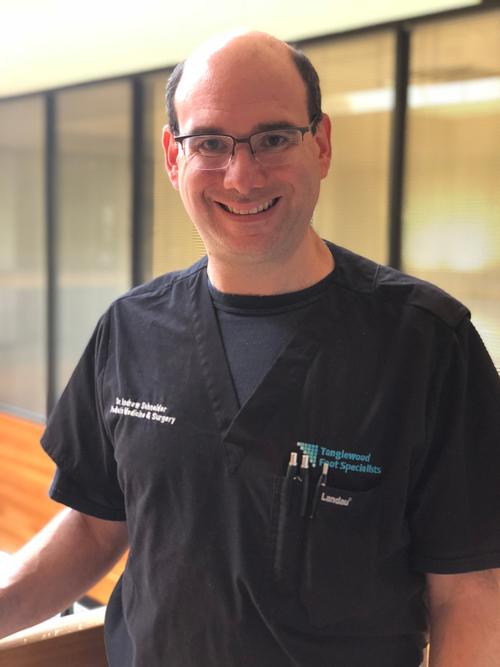
Ready to stop dealing with heel pain and get back to the activities you love? Contact your Houston podiatrist Dr. Andrew Schneider for an immediate appointment. Give us a call at 713-785-7881 or request an appointment online. The sooner we identify what's really causing your heel pain, the faster we can start treatment that actually works.
Houston Foot & Ankle Specialist Dr. Andrew Schneider offers comprehensive heel pain diagnosis and treatment including custom orthotics, shockwave therapy, PRP injections, and minimally invasive surgery to residents of Houston, Texas and surrounding areas. Contact us today for an immediate appointment at 713-785-7881.