What Is Lapiplasty® 3D Bunion Correction?
Lapiplasty® 3D Bunion Correction is a surgical procedure that corrects bunions by rotating the entire first metatarsal bone back to its normal position and permanently fusing the unstable joint in the midfoot.1 Unlike traditional bunionectomy that only shifts the bone sideways, Lapiplasty addresses the three-dimensional rotation that causes bunions to recur.
 Here's the difference that matters. Traditional bunion surgery tries to fix the problem by cutting the bone and shifting just the top part over—kind of like straightening a leaning tower by adjusting the top floors. But the foundation is still unstable, so that bunion drifts back over time. That's why you see recurrence rates of 25-50% with old-school bunionectomies.
Lapiplasty goes down to the actual problem—that unstable joint in the middle of your foot called the first tarsometatarsal (TMT) joint. When this joint moves too much (doctors call it "hypermobile"), your metatarsal bone rotates in three dimensions: it drifts sideways toward your other toes, it rotates outward, and it tilts upward. The visible bunion bump is just the end result of all that twisted bone.
Think of your foot like the Leaning Tower of Pisa. Traditional bunion surgery tries to straighten the top of the tower by cutting and shifting the lean—but the foundation is still unstable, so it leans again over time. Lapiplasty goes down to the foundation, straightens the entire tower, and permanently stabilizes the base by fusing that joint. That's why recurrence drops to 1-3%.
I know "joint fusion" sounds scary. But here's the thing—that joint in your midfoot isn't supposed to move much anyway. When it IS unstable, that's what causes your bunion in the first place. The surgery uses titanium plates (what we call "biplanar plating") on the top and side of your bone to hold everything in the corrected position.2 And because of that solid fixation, most patients can start walking in a protective boot within days instead of being completely off their foot for 6-8 weeks.
Understanding the "97% Success Rate"—What It Really Means
Here's what that 97% number actually tells you—and what it doesn't. That statistic comes from a 2019 study that followed Lapiplasty patients for 13 months after surgery.3 They found that 97.3% of patients maintained what doctors  call "radiographic correction"—meaning the angles on their X-rays stayed in the corrected position.
But those researchers were measuring hallux valgus angle (HVA) and intermetatarsal angle (IMA) on X-rays. The HVA is the angle between your big toe and the metatarsal bone behind it. Normal is less than 15 degrees. The IMA is the angle between your first and second metatarsal bones—normal is less than 9 degrees. Success in that study meant your HVA stayed below 20 degrees after surgery.
What most people don't realize is that you can still have a mild visible bump at 19 degrees. And that 13-month study didn't measure pain levels, patient satisfaction, whether you could wear the shoes you wanted, or if you were happy with the cosmetic result. It definitely didn't tell us what happens at 5 or 10 years.
The longer-term data is getting better. A 4-year study showed that 92% of patients maintained their correction at four years post-surgery.4 Recurrence rates vary depending on how strictly you define "recurrence"—if you define it as the HVA going back over 20 degrees, it's only 0.8%. But if you use a stricter definition of HVA over 15 degrees, that recurrence rate jumps to 8.4%.
Compare that to traditional bunionectomy, where research shows recurrence rates of 25-50% because those surgeries don't address the unstable joint—they just shift the visible bone.5 The bunion looks better initially, but over months or years, that unstable foundation lets the bone drift back.
In my experience, about 85-90% of my Lapiplasty patients tell me they'd do it again. The patients who do well tend to have moderate-severe bunions, they're committed to following the recovery protocol (especially that boot-wearing phase), and they have realistic expectations. The ones who struggle? Usually they had mild bunions that probably didn't need surgery in the first place, or they didn't follow weight-bearing restrictions, or they expected cosmetic perfection.
Some patients define success as "no more pain." Others want to wear heels again. We need to get clear on YOUR goals before deciding if this is right for you.
The 3-8% Who Experience Problems
Let's talk honestly about the patients who don't do well. The 3-8% who experience recurrence or complications usually fall into a few categories. Severe osteoporosis means the bone doesn't fuse properly—there's just not enough bone density to hold the correction. Smokers have delayed bone healing because nicotine constricts blood vessels and reduces oxygen delivery to the fusion site.
Non-compliance with the boot protocol is a big one. I get it—by week 4, that boot feels like a prison and your foot feels fine. But "feels fine" doesn't mean the bone has fused. If you start walking normally at week 4 instead of week 8, you're putting forces on that joint before it's healed, and the correction can fail.
And then there are unrealistic expectations. If you're expecting your foot to look exactly like it did at age 20, or you think you'll definitely be able to wear 4-inch stilettos again, that's not what this surgery promises. It corrects the deformity and eliminates pain for the vast majority of patients—but it doesn't guarantee a specific cosmetic outcome or return to every single activity you did before the bunion developed.
MYTH: "97% success rate means my bunion will definitely be fixed and I'll love the results"
TRUTH: That statistic measures X-ray correction at 13 months—not pain relief, shoe-wearing ability, or patient satisfaction. Most patients ARE happy (85-90% in satisfaction surveys), but it's not a guarantee.
WHY THE CONFUSION: Manufacturer marketing emphasizes success rates without explaining measurement methodology or timeframes. They're not lying—the study results are real—but the context matters.
Who Is (and Isn't) a Good Candidate for Lapiplasty
Look, I'm not going to operate on a mild bunion that only hurts when you wear heels. That's not a good use of surgery—or your money.
But if you're avoiding exercise, struggling to find ANY comfortable shoes, and you've been dealing with this for years? We should talk.
I Recommend Lapiplasty for:
Moderate-severe bunions where your big toe is angled more than 25 degrees toward your other toes (HVA >25°) and the space between your first and second metatarsal bones measures more than 13 degrees (IMA >13°). At that severity, conservative care is basically just damage control.
Bunions with metatarsal rotation where the bone has actually twisted, not just drifted sideways. This is the classic Lapiplasty patient—traditional surgery might shift the bone over, but it won't correct the rotation. Six months later, that bunion's coming back.
Failed conservative care for at least 6 months. I'm talking custom orthotics, wide shoes, activity modifications—the whole playbook. If you've done all that and you're still in pain, conservative care has given you everything it's going to give you.
Functional limitations that actually impact your daily life. Can't exercise? Your bunion pain prevents you from doing your job on your feet? You're limping by the end of the day? Pain wakes you up at night? Those are functional problems that justify surgical risk.
Recurrent bunions after traditional surgery failed. If you had a bunionectomy 5 or 10 years ago and the bunion came back, that's because the surgery didn't address the unstable joint. Lapiplasty fixes what the first surgery missed.
Active patients under 60 who want to get back to hiking, running, or sports. You've got decades of active life ahead—living with progressive bunion pain for the next 30 years isn't a great option.
I Don't Recommend Lapiplasty for:
Mild bunions with minimal pain where the deformity is cosmetic and doesn't limit your activities. Not worth the surgical risk. We can manage symptoms with shoes and orthotics for years.
Severe arthritis in the big toe joint where the MTP joint (where your toe bends when you walk) is already bone-on-bone. At that point, you might need fusion of the big toe joint itself, not just the midfoot joint. Different surgery.
Poor bone density or osteoporosis where a DEXA scan shows significant bone loss. The fusion might not heal because there's not enough healthy bone to fuse together. We'd need to optimize your bone health first—maybe for 6-12 months—before considering surgery.
Uncontrolled diabetes with an HbA1c over 8.0. High blood sugar dramatically increases infection risk and delays wound healing. I need your diabetes well-controlled before we can safely proceed.
Peripheral artery disease where poor circulation to your feet means delayed healing or wound complications. We'd need vascular studies and possibly consultation with a vascular surgeon first.
Unrealistic expectations like "I want to wear stilettos again" or "my foot will look perfect." No surgery guarantees specific cosmetic outcomes or return to every activity. If that's your primary goal, you're going to be disappointed.
Either Way, I Need to See You
Even if you're not sure you're a candidate, an examination and X-rays give us a clear answer. I can measure those angles, assess your bone quality, check for arthritis, and test that TMT joint stability. Then we'll have an honest conversation about your options.
I won't recommend this surgery unless I genuinely believe the conservative options have been exhausted. But I also won't string you along with treatments that can't fix a structural bone problem. You deserve honesty about what will—and won't—work for your specific situation.
Houston Podiatrist Treats Bunions with 5-Level Approach
I don't jump straight to surgery. But I also don't string you along with treatments that won't work. My treatment philosophy is "goals-over-symptoms"—we start with the least invasive options and escalate only when necessary.
Here's the reality about bunions: unlike plantar fasciitis or Achilles tendinitis, this is a structural bone problem. Conservative care manages pain but doesn't reverse the deformity. That said, not everyone needs surgery. Here's how I decide.
Level 1: Lifestyle Changes
Sometimes, fixing a bunion problem is as simple as changing your shoes. Wide-toe-box shoes (Altra, Hoka, New  Balance in wide widths) take pressure off that bunion bump by giving your toes room to spread naturally. Activity modification matters too—switching from high-impact running to cycling or swimming reduces the pounding forces that aggravate bunion pain. Ice after activity (15-20 minutes) brings down inflammation. And silicone toe spacers worn at night can gently encourage your toes back toward better alignment, though they won't reverse the bone rotation.
Timeline-wise, you'll feel immediate relief from shoe changes—sometimes within days. Activity modification reduces pain within 1-2 weeks. And the honest truth? About 30-40% of mild bunion patients manage long-term with footwear alone. This is NOT a cure—the bunion will slowly get worse over years—but it buys time.
One Houston-specific tip: Texas heat means your feet swell more, especially during our humid summers. I tell my patients to size up their shoes by half a size from May through September. And if you're walking or running on those concrete surfaces at Memorial Park or Buffalo Bayou trails? Your bunion is going to feel every step. Stick to grass or rubberized tracks when possible—your feet will thank you.
When to escalate: If pain interferes with daily activities despite shoe changes, we need to do more.
Level 2: At-Home Care
Now, for some of you, adding at-home treatments to those shoe changes may be enough. Toe stretches (gently pulling your big toe away from the other toes for 30 seconds, three times daily) maintain flexibility. Bunion pads—those gel cushions you can pick up at CVS or Walgreens—cushion the bump and reduce friction inside your shoes. Oral NSAIDs like Advil or Aleve (taken with meals to protect your stomach) reduce inflammation. Contrast baths (alternating hot and cold water) can ease pain after a long day on your feet.
What works: Bunion pads plus wide shoes give decent symptom management for mild-moderate bunions.
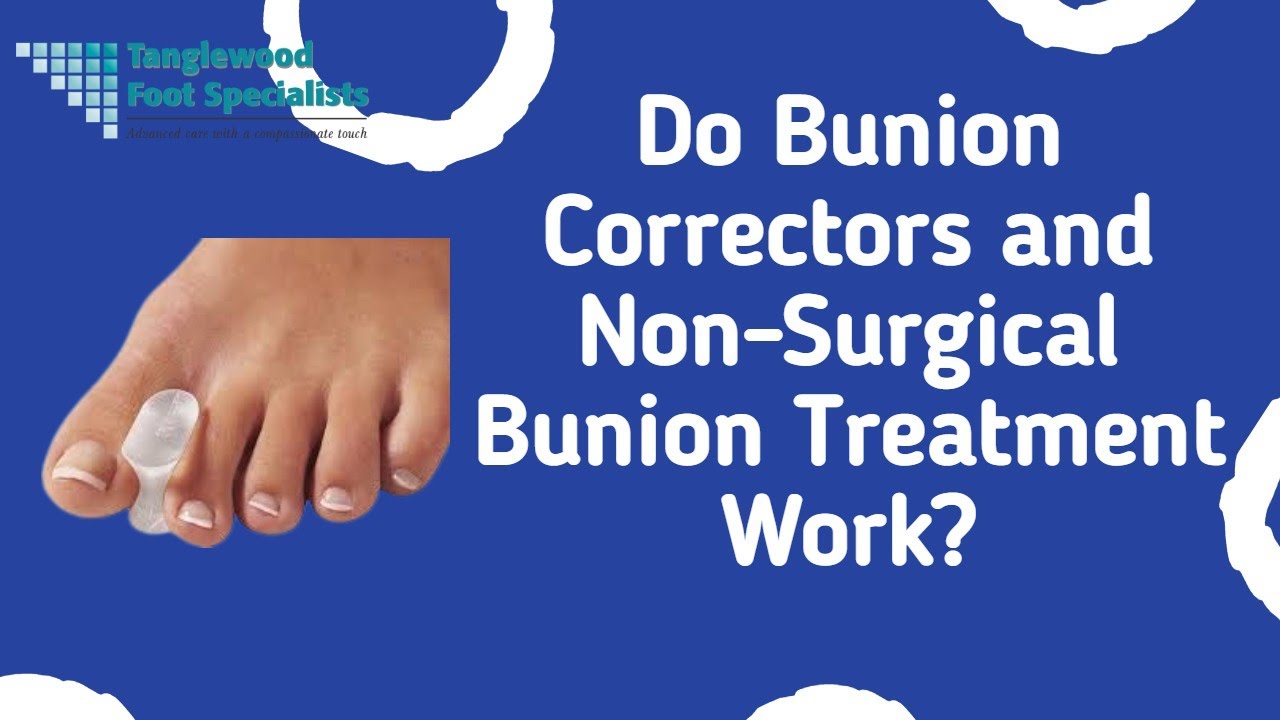
What doesn't work: those "bunion corrector" splints you see all over Amazon. Multiple studies show they don't change bone position long-term. You might feel temporary relief from the stretching sensation, but the moment you take the splint off, that bone goes right back to where it was. Essential oils won't help either, and definitely don't fall for topical creams that claim to "dissolve the bunion"—you can't dissolve bone.
Here's the limitation you need to understand: these are band-aids.
The bone is still rotated, the joint is still unstable. You're managing symptoms of a structural problem—and over time, the structure gets worse. All the padding and splints in the world are like putting fresh paint on a house with a cracked foundation. It might look better temporarily, but the foundation is still broken.
Level 3: Conservative In-Office
When that's not enough, we can bring in professional-grade conservative treatments. When you come in, I'll start with X-rays to see how severe the deformity is—both the angle of your toe and whether the bone has rotated.
Custom orthotics redistribute pressure off the bunion bump and support your arch (especially important if flat feet are  contributing to progression). The success rate here is solid—about 40-50% of patients get 1-3 years of pain relief with orthotics plus proper shoe modifications. There's an adaptation period of 2-3 weeks where the orthotics might feel weird, but you'll notice the full benefit by 6-8 weeks. Cost runs $400-600, often insurance-covered after your deductible. Custom orthotics can't fix bunions, but they CAN buy you time by redistributing pressure off that painful bump.
When orthotics aren't enough: If pain persists despite proper orthotics and wide shoes, the bunion deformity is too severe for conservative care alone.
Cortisone injections reduce inflammation in the MTP joint (that's the joint where your big toe bends—NOT the bunion bump itself). These work well for bunion-associated arthritis. About 60-70% of patients get 6-12 weeks of temporary relief. But here's the thing—cortisone is a bridge, not a solution. I limit patients to 2-3 injections per year because repeated cortisone weakens tendons over time. Cost runs $150-250 per injection, often covered after your deductible.
Physical therapy for 6-8 weeks (usually twice weekly) has minimal effect for bunions themselves because you can't rotate bones with exercises. But it's genuinely helpful for secondary issues like hammertoes or ball-of-foot pain (metatarsalgia) that often develop alongside bunions.
When to escalate: If you've done 3-6 months of conservative care with no improvement, the bunion prevents comfortable shoes, pain impacts your sleep or work or exercise, or X-rays show the deformity is worsening—we need to talk about more advanced options.
Level 4: Advanced Regenerative (The Third Option)
Look, I'm a big believer in regenerative medicine—it's saved hundreds of my patients from heel surgery, Achilles surgery. But bunions? The Third Option has limited power here because the problem is mechanical. Imagine trying to fix a twisted car frame with lubrication—doesn't matter how good the oil is, the frame is still bent.
Where it DOES help: PRP injections for bunion-associated MTP arthritis reduce inflammation and may delay surgery 6-12 months. Shockwave therapy for the inflamed bunion bursa (that fluid-filled sac over the bump) or the tight flexor hallucis longus tendon running underneath your big toe can provide relief.
My combined protocol uses a PRP injection into the MTP joint plus shockwave therapy to the bunion bursa. That's 3 treatments over 6 weeks, then we reassess at 12 weeks. Success rate: 50-60% get 6-12 months of additional symptom control. It buys time, but it doesn't fix the deformity.
Here's my honest assessment: Regenerative medicine can help the pain AROUND the bunion, but it can't un-twist the bone. If your bunion is progressing and conservative care has failed, we're looking at surgery. I won't string you along with injections that delay the inevitable.
Level 5: Lapiplasty Surgery
When Necessary: Conservative care exhausted, significant deformity (HVA >25°, IMA >13°), and functional limitations that impact your daily life.
What I Do (The Surgical Steps—Simplified):
I make a 3-4 cm incision on top of your foot over the TMT joint (that's in your midfoot, not over the bunion bump itself). Then I rotate the entire first metatarsal bone back to its anatomically correct position—all three dimensions: sideways drift, rotation, and upward tilt. I remove the cartilage from both TMT joint surfaces so bone can fuse to bone. I apply controlled compression to squeeze those joint surfaces together, which promotes fusion. Then I insert biplanar titanium plates (one on top, one on the side) with screws to lock everything in the corrected position.
Surgery time runs 60-90 minutes. You're either under general anesthesia or you get a regional nerve block (asleep or numb from the knee down). This is outpatient surgery—you go home the same day.
Recovery Timeline Highlights:
Week 1 means couch life, non-weight-bearing for the first 48-72 hours, and moderate pain (5-7 out of 10 even with meds). Days 3-10, you start walking in the boot (average day 7-8 in published studies). Weeks 6-8, you transition to athletic shoes if X-rays show good healing. Months 3-4, you can start low-impact exercise like cycling or swimming—no running or jumping yet. Months 5-6, you get full activity clearance for running and sports if X-rays show complete fusion.
Success Rates (The Specific Data):
Radiographic correction holds up in 97-99% of patients at 12-17 months, and 92% maintain it at 4 years. Recurrence runs 0.8-3% at 13-48 months (compared to 25-50% for traditional bunionectomy).1 Patient satisfaction sits at 85-90% satisfied or very satisfied at 12+ months. Return to work averages 27 days (4 weeks). Return to full activity averages 4 months. Complications include non-union in 0-3%, infection in 1-2%, hardware removal in 1-3%, and nerve injury in 5-10% (often temporary).
Look, I know foot surgery sounds scary. I've done hundreds of Lapiplasties, and I won't sugarcoat it—the first week is uncomfortable. You'll be on the couch a lot, icing and elevating. But here's what I want you to know: Lapiplasty has changed bunion surgery. My patients who had old-school bunionectomies 10+ years ago—they were non-weight-bearing for two months, bunions came back half the time, it was brutal.
With Lapiplasty, you're walking in a week, and that 97% success rate is real because we're fixing the root cause—the unstable, rotated bone. I won't recommend this surgery unless I genuinely believe the conservative options have been exhausted. If we've done orthotics, changed your shoes, tried injections, and you're still in pain that's impacting your life? Then surgery makes sense.
Houston-Specific Recovery Tip: One thing I tell my Houston patients: that first 6 weeks when you're in the boot, it's going to be hot. Texas summer heat makes that boot feel like a sauna, and humidity causes more swelling. Ice religiously—15-20 minutes every 2 hours. And if you can, schedule your Lapiplasty in fall or winter when temperatures are in the 60s and 70s. Recovery is so much more comfortable when you're not sweating through the boot in August.
Ready to find out if Lapiplasty is right for you? I'll examine your foot, review X-rays, and give you honest guidance on whether surgery makes sense—or if we can buy you more time with conservative care.
Schedule Your Bunion Consultation
Call 713-785-7881 or request an appointment online.
What to Expect During Lapiplasty Recovery—Week by Week
Recovery is the part most manufacturer websites gloss over. They'll tell you "walk within days!" without explaining what that actually looks like.
Here's the reality:
Week 1 (Post-Op Days 1-7): You're resting and elevating your foot above heart level 23 hours a day. Ice goes on for 20 minutes every 2 hours. Pain runs moderate—5-7 out of 10. That nerve block lasts about 24 hours, then you'll need prescription pain meds for 3-5 days. Most patients transition to Tylenol or Advil by day 4-5. You're non-weight-bearing for the first 48-72 hours (crutches or knee scooter). Around day 3-7, you start putting weight down in the surgical boot—depends on what your X-rays show at that first post-op visit. Expect significant swelling—your foot will look like a balloon. This is normal. Keep it elevated.
Weeks 2-3: You're walking in the boot around the house, still elevating when sitting. You can do desk work from home if you can keep your foot elevated. Pain drops to 3-5 out of 10, mostly managed with Advil. Driving is a no if it's your right foot. Left foot is okay (automatic transmission only) if you're off pain meds. Sutures come out at the week 2 visit if they're non-absorbable.
Weeks 3-6: Walking in the boot for all activities, gradually increasing distance. You can return to desk work (with the boot). Pain is down to 2-4 out of 10, more of a dull ache. Week 6 X-rays confirm bone healing—fusion starts around week 6-8. Swelling is still present, especially at the end of the day. Better in mornings.
Weeks 7-8: If X-rays show good healing, you transition to athletic shoes with stiff soles (Hoka, Brooks). No flip-flops, heels, or flexible shoes yet. Physical therapy is optional—I'll refer you if you're having trouble with your gait or you've got ankle or toe stiffness. Pain runs 1-3 out of 10, mostly swelling discomfort.
Months 3-4: Gradual return to low-impact exercise—cycling, elliptical, swimming. No running or jumping yet. Most normal shoes are okay now (sneakers, flats, boots). Still avoiding heels and very tight shoes. Swelling is decreasing but still present after long days on your feet. Return to full duty at work if your job involves standing or walking.
Months 5-6: High-impact sports (running, tennis, basketball) are allowed if X-rays show complete fusion. Final assessment X-rays confirm the fusion and that correction is maintained. Swelling can persist up to 9-12 months—completely normal. Worst in the evenings, better with compression socks.
I tell my patients: the first week, you're going to be bored. Netflix is your friend.
That boot is going to feel like a prison by week 4. But wear it. Skipping the boot because "it feels fine" is how that 3% recurrence happens.
Swelling for 9-12 months sounds crazy, but it's completely normal. Don't panic when your foot looks puffy at 6 months—it's still healing internally.
Lapiplasty Cost and Insurance Coverage in Houston
I know cost is a huge factor in your decision. I won't pretend Lapiplasty is cheap.
Typical cost range runs $8,000-$15,000 total when you add up surgeon fees, facility fees, anesthesia, and the titanium hardware.
At Tanglewood Foot Specialists, Lapiplasty typically ranges from $10,000-$13,000 depending on complexity and whether we're addressing other issues at the same time, like hammertoes or bunionettes.
Insurance coverage reality: Most commercial insurance and Medicare covers Lapiplasty when it's medically necessary. "Medically necessary" means you've failed conservative care (orthotics, shoe modifications) for 3-6 months and you have documented pain or functional limitations. You'll need pre-authorization before surgery.
What you'll actually pay: If your deductible is $2,000 and your coinsurance is 20%, you might pay $4,000-$4,600 out of pocket after insurance processes the $12,000 claim. We'll work with your insurance to get pre-authorization before surgery so there are no surprises.
Self-pay and payment plans are available for uninsured patients or those with high-deductible plans. What insurance won't cover: cosmetic bunion surgery where there's no pain, just appearance concerns.
But here's what I tell patients: if your bunion is preventing you from exercising, impacting your work, or causing chronic pain—that has a cost too. We'll give you a cost estimate after your consultation so you can make an informed decision. No surprises.
What to Expect When You Come to Tanglewood Foot Specialists
When you come in, I'll start by listening to your story. How long have you had the bunion? What have you tried? What activities does it prevent you from doing?
Then I'll examine your foot. Visual assessment shows me bunion size, toe alignment, and skin condition over the bump. I'll palpate to check for arthritis in the MTP joint and assess TMT joint stability—is it hypermobile? I'll watch you walk barefoot so I can see how the bunion affects your mechanics. Weight-bearing X-rays are critical because standing X-rays show the true deformity. I'll measure your HVA (hallux valgus angle) and IMA (intermetatarsal angle) and check for arthritis.
After examination and X-rays, we'll talk about your goals—what do you want to be able to do that you can't do now? If your bunion is mild-moderate and we haven't exhausted conservative care, I'll tell you. If it's time for surgery, I'll explain why—and I'll also tell you what to expect realistically.
I'm not here to talk you into surgery. I'm here to give you honest guidance. You don't have to decide today. This is your foot, your decision. Some patients leave my office with orthotics and a plan to revisit in 6 months. Some schedule surgery that day.
After treating thousands of Houston patients with bunions, I've learned that the examination tells me what's wrong—but the conversation with YOU tells me what's right.
Timeline expectations: If you decide on Lapiplasty, we'll schedule a pre-op appointment, get insurance authorization (usually takes 1-2 weeks), then book your surgery date 3-4 weeks out.