What Are Mosaic Warts?
 Mosaic warts are clusters of multiple plantar warts — warts on the bottom of the foot — that have grown together in a tile-like pattern. Caused by the human papillomavirus (HPV), they share a connected blood vessel network beneath the skin, which makes them significantly harder to treat than a single, isolated plantar wart. The name comes from the way they look: a rough, patchy arrangement of fused lesions that resembles tiles laid together on a floor.
Here's what's actually happening beneath the surface. When HPV enters a small break in the skin — a tiny cut, a crack in dry skin, or even just the micro-abrasions you pick up walking barefoot — it takes up residence in the skin cells of the plantar surface (the bottom-facing sole of your foot) and starts replicating. In a solitary wart, the infection stays contained. In a mosaic cluster, individual wart lesions begin growing next to each other, sharing blood vessel infrastructure as they expand. By the time you can see the cluster clearly, it's already a biologically connected colony — not just several warts sitting close together.
You might notice that the patch looks darker in spots, with tiny black or brown specks scattered across the surface. Those aren't seeds or roots — I'll address that myth in a moment. They're punctate hemorrhages: small blood vessels that grew into the wart tissue and clotted off. Their presence is one of the first things I look for, because it immediately tells me I'm dealing with a wart colony, not a callus.
The skin ridges — those fingerprint-like lines on your sole — also disappear across wart tissue. They don't disappear over corns and calluses. That diagnostic distinction changes the entire treatment path.
And there's one more layer to the biology that explains a lot. HPV specifically evades the immune system — it doesn't trigger the redness, swelling, and inflammation that flag a typical infection. Your immune system essentially can't see it.1 Think of it like a greenhouse effect: Houston's heat and humidity, combined with the dark, warm interior of a closed-toe shoe, create exactly the growing conditions HPV thrives in. The virus doesn't need to fight your defenses — it just needs time and the right environment.
Why Mosaic Warts Are So Hard to Treat
Here's what most people don't realize about mosaic warts: treating one spot in the cluster doesn't threaten the rest of it. The colony shares blood supply and viral load across every connected lesion. When you apply salicylic acid to the most visible wart, the adjacent lesions — drawing from the same vascular network — keep expanding. You're addressing the symptom while the infrastructure driving it goes untouched.
The penetration problem makes this worse. OTC salicylic acid reaches maybe 1–2 millimeters into the skin under ideal conditions, and a mosaic cluster almost always has a thick layer of overlying callus blocking it further. The acid never gets close to the active viral layer beneath. Pharmacy freeze sprays have a different version of the same problem: they reach approximately −70°F. Clinical liquid nitrogen in a podiatrist's office reaches −320°F. That's not a minor gap — it's an entirely different category of treatment.
But the deeper issue is the immune evasion. Your immune system started a response when the virus first entered, but HPV made itself invisible — like a construction crew that showed up, looked at the job site, and left without doing anything. Every month the colony sits there, it's not just persisting — it's growing, spreading satellite lesions, and becoming harder to clear. Single plantar warts sometimes self-resolve over one to two years, but mosaic clusters almost never do — expansion is the more common outcome.2
This is why switching from OTC products to professional care isn't just a matter of trying harder. It's a matter of using a treatment that actually matches the biology. That's what Swift therapy does that nothing else can — and I'll walk through exactly how in the treatment section.
The Truth About Wart "Seeds," Roots, and Other Mosaic Wart Myths
A few persistent myths about mosaic warts are worth addressing directly, because acting on them can make the infection worse — not better.
 Myth 1: Warts have roots or seeds that need to be dug out. The black specks you see in the wart tissue are clotted blood vessels, not roots or seeds. There's nothing to excavate. When people try to dig or pick at wart tissue — and I see this regularly — they risk autoinoculation: spreading HPV to surrounding skin by direct contact with shed viral material. You can turn a small cluster into a much larger one this way, and you can create permanent plantar scarring in the process.
Myth 2: Treat one wart in the cluster and the rest will follow. This is single-wart logic applied incorrectly to a colony. Because the cluster shares blood supply and viral infrastructure, spot treatment never activates an immune response to the whole colony. The treated lesion may improve while adjacent lesions connected to the same network keep growing.
Myth 3: They'll go away if you wait long enough. This one's partly true for solitary warts — about 65% of single cutaneous warts resolve within two years, particularly in younger people. Mosaic clusters are a different story. The shared colony structure and HPV's immune evasion mean spontaneous resolution is rare. I've seen people spend 18 months cycling through every drugstore product on a mosaic colony that doubled in size during that time. I won't judge you — every one of those products promised results. But mosaic warts don't respond to patience with the wrong approach. They respond to the right one.
How a Houston Podiatrist Treats Mosaic Warts — From First Visit to Clear Skin
After treating thousands of patients with plantar warts — from a single small lesion to colonies covering most of a heel — I've learned that mosaic warts need a fundamentally different approach than single warts. My goal is always to get you to clear skin with the least invasive path possible. Here's exactly how I think through your options.
Lifestyle and Protective Measures
The first thing I ask every patient to do costs nothing and starts the same day.
Wear shower shoes in all Houston public wet areas — gym locker rooms, pool decks, hotel showers. Change your socks daily, and again midday if your feet sweat heavily during Houston summers. Rotate between at least two pairs of shoes, with a minimum 24 hours of drying time between wears — Houston's humidity slows that process, so don't rush it. Cover active warts with waterproof bandaging before any shared-surface activity.
None of this eliminates an existing colony, but it stops new satellite lesions from forming while we treat what's already there.
At-Home Care — An Honest Assessment
OTC salicylic acid at 17% concentration has some legitimate value as a debulking tool. Applied consistently with pumice filing between applications, it can thin the overlying callus and reduce pressure pain during walking. That's real, and it's worth doing alongside professional care. But I want to be direct about what it can't do: it can't reach the active viral layer beneath a mosaic cluster, and systematic reviews show a cure rate of roughly 13–14% for salicylic acid on plantar warts — even lower on established mosaic colonies.3
OTC freeze sprays don't work on mosaic clusters — not because you're using them incorrectly, but because ~−70°F simply can't penetrate deep enough to reach the tissue that needs treatment. If you've been at it for four to six weeks with no measurable reduction in colony size, that's your signal. Hoping doesn't work — and every additional month typically means a larger, harder-to-treat colony.
Conservative In-Office Treatment
Clinical cryotherapy with liquid nitrogen is a categorically different tool than anything in a pharmacy. At −320°F, it penetrates to a depth that actually destroys wart tissue — not just the surface callus. For mosaic clusters, I address all visible lesions at every session, spaced two to three weeks apart, and most cases require four to eight sessions for significant clearance. You'll experience moderate discomfort and blistering over 24–48 hours, but there's no downtime. Research shows cryotherapy achieves clearance in roughly 46–58% of plantar wart cases — a meaningful improvement over OTC options, but with higher recurrence than Swift because it doesn't train the immune system.3
I also use cantharadin — a topical agent sometimes called "beetle juice" — applied directly in-office. It causes a controlled blister to form under the wart tissue, lifting the infected layer for debridement at your follow-up visit. The application is painless, and it can be combined with cryotherapy for deeper penetration on thicker lesions. Success rates run 50–70% depending on lesion depth and immune status. If we haven't seen significant clearance after three to four cryotherapy sessions, or new lesions keep appearing during treatment, that's my signal to move to Swift.
Swift Therapy — The Treatment That Matches Mosaic Wart Biology
This is where the story changes.
 For mosaic warts specifically, Swift is often where I start — not where I end up after everything else has failed.
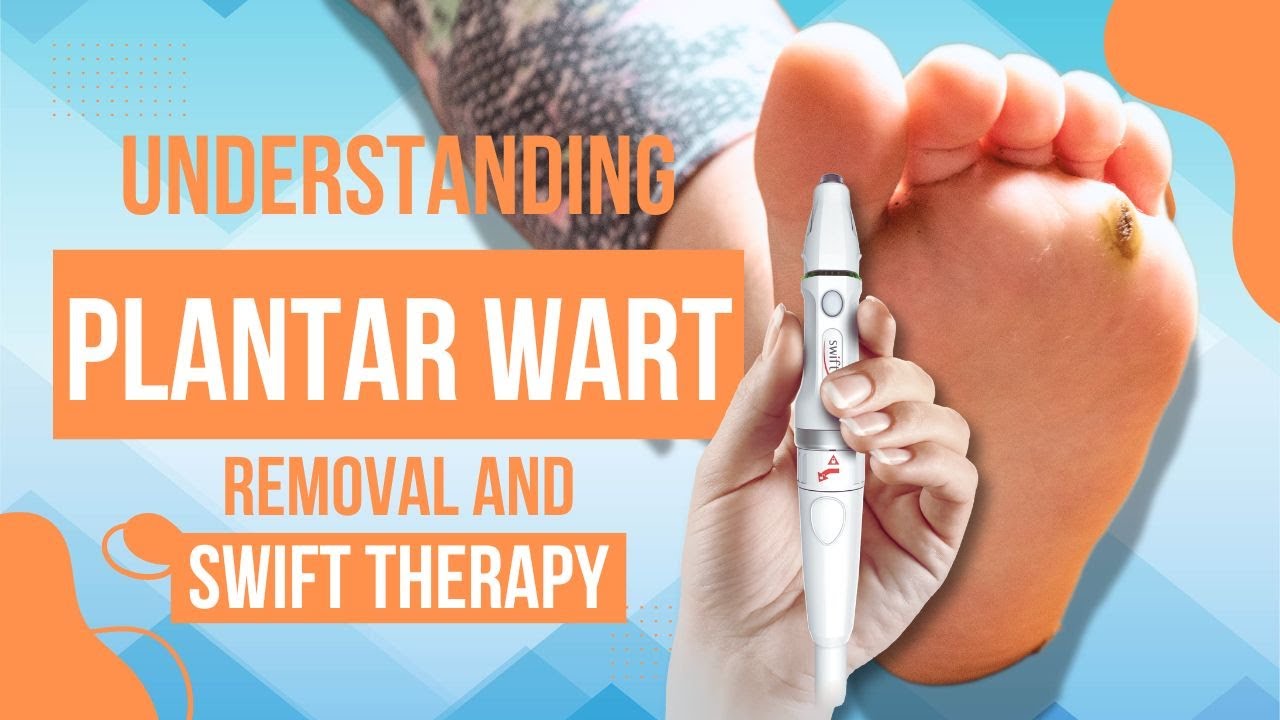
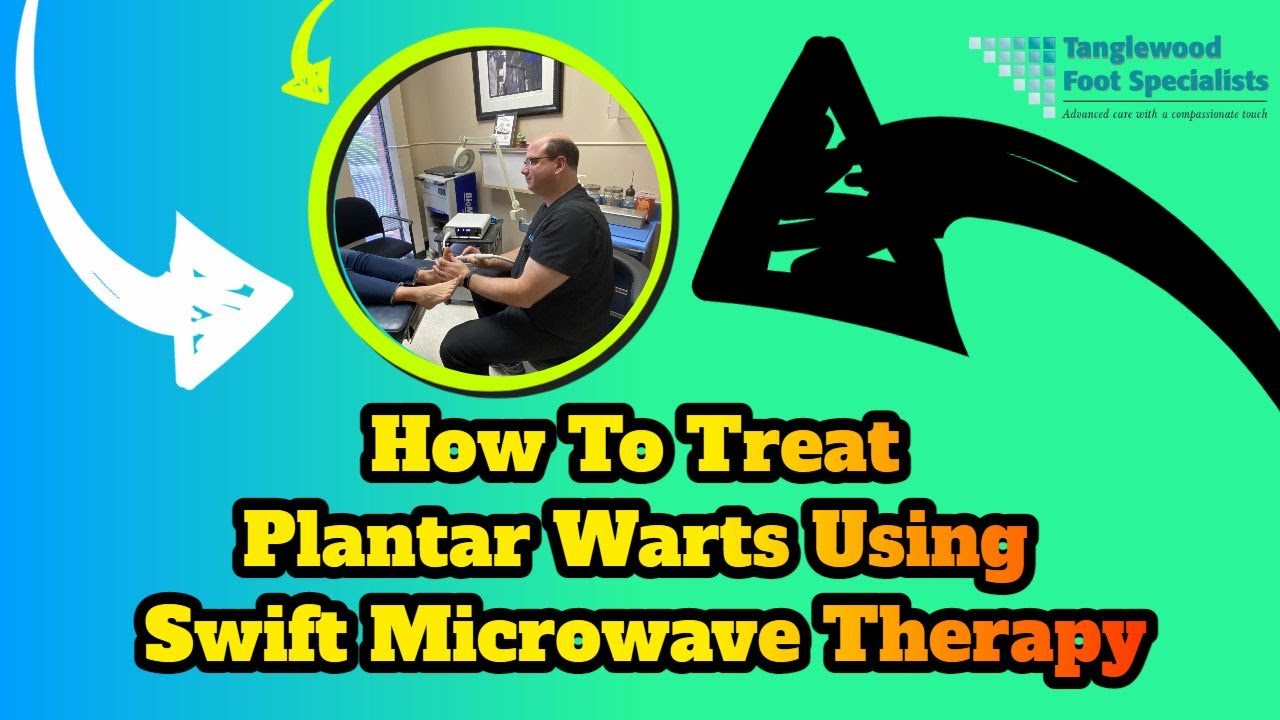
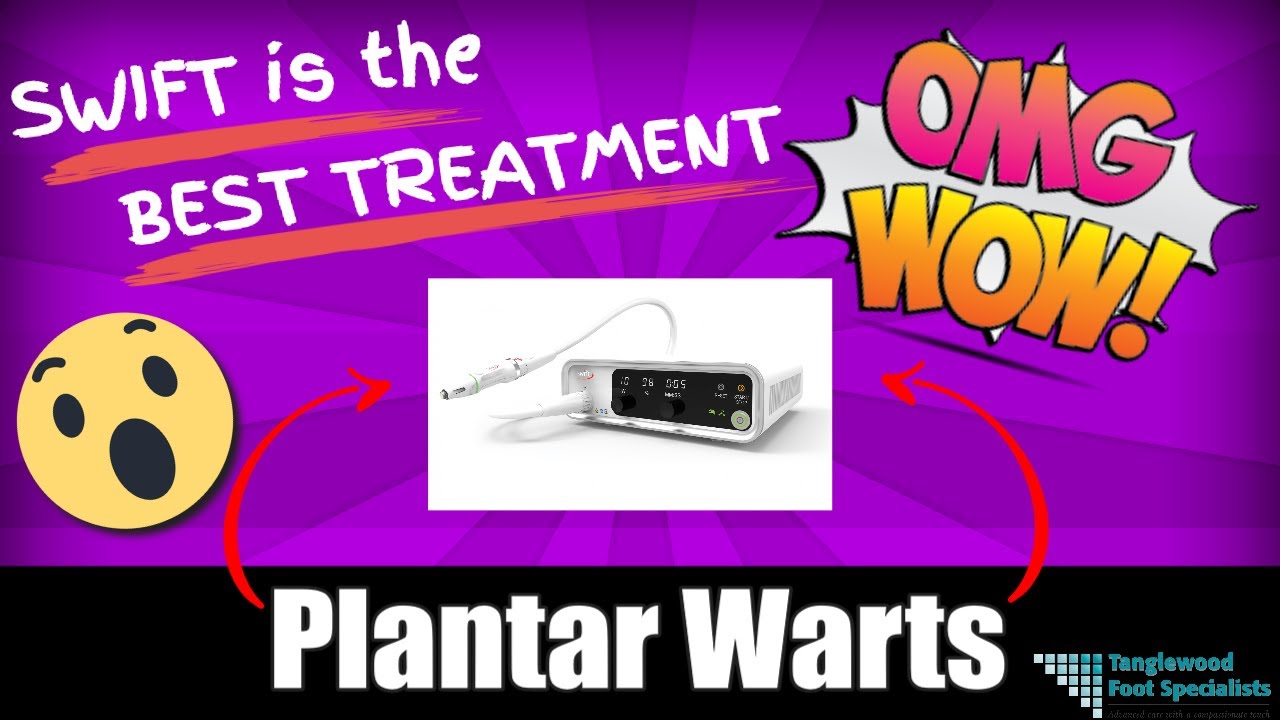
Swift treatment for plantar warts uses precisely calibrated microwave energy delivered through a probe applied directly to the wart tissue. The microwaves heat water molecules within and around the wart cells, creating localized cell disruption. Here's the critical part: that disruption unmasks HPV viral proteins that were previously hidden from your immune system. Your body mounts a response — not just to the treated lesion, but to the entire colony simultaneously.
Swift doesn't destroy tissue spot by spot the way cryotherapy does. It activates colony-wide immune recognition — the only thing that actually matches the biology of a mosaic cluster.
Each session takes under ten minutes. The schedule is three to four sessions spaced four weeks apart — a total course of three to four months. No anesthesia, no bandaging, no downtime. You walk out and return to all activities immediately. Discomfort is typically rated 3–5 out of 10 for the few seconds the probe contacts each lesion, and it fades within seconds of the probe lifting. No scarring, because Swift doesn't break the skin.
The numbers back it up: plantar wart removal with Swift achieves an 83–84% clearance rate in people who complete the full treatment series — compared to roughly 46% with cryotherapy and 14% with salicylic acid alone.4 And because it works through immune activation rather than tissue destruction, it addresses the entire colony — including satellite lesions that haven't surfaced yet — through a single trained immune response. That's why I connect it to our broader regenerative medicine Houston philosophy: the goal is always to engage your body's own healing capacity, not just destroy tissue and hope for the best.
Cash price: $265 per Swift session. Most mosaic wart cases clear in three to four sessions — a total investment of $795–$1,060.
Surgery — Rare, and Only When Necessary
Look, I know foot surgery sounds scary — and I want to be direct: surgical excision for mosaic warts is genuinely rare in my practice. Most people clear completely with Swift before we ever have that conversation. But for large colonies that haven't responded to a complete Swift series, or for people who are significantly immunocompromised, foot surgery Houston is an option. The procedure removes wart tissue under local anesthesia and cauterizes the base.
Here's the honest recovery picture. Week one is bandaged, with protected weight-bearing in a surgical shoe. By week six you're in normal shoes; by month three you're fully healed. I also want you to know the real tradeoff: excision creates scar tissue on the plantar surface, and a painful plantar scar can outlast the original wart. Recurrence after surgery is possible, because it doesn't train the immune system. Every non-surgical option gets exhausted first — every time.
Done Watching That Colony Grow?
If this sounds like what you're dealing with, don't wait for it to expand further. Request an appointment at our Tanglewood practice and you'll have a clear treatment plan before you leave.
Request Your Appointment
What to Expect at Your First Visit
When you come in, I'll start by examining the entire sole of your foot — not just the visible cluster. Mosaic colonies often have satellite lesions that haven't fully surfaced yet, and mapping the full picture changes how we plan treatment. I'll use two quick diagnostic tests: the skin line test, where I check whether the natural ridge patterns on your sole disappear across the patch (they do over wart tissue; they don't over callus), and the lateral compression test, where I apply gentle side pressure to the cluster. Pain from that side pressure is a reliable sign you're dealing with a wart colony and not a thickened callus. In most cases, I can confirm the diagnosis without a biopsy.
Then we'll talk through your options based on what I find — the size of the colony, how long it's been there, whether you have health factors like diabetic foot care concerns that change the calculus, and how aggressively you want to move. If Swift is a good fit, we can often begin treatment that same visit. I'll ask you to schedule an appointment for the next session four weeks out, and we'll repeat that three to four times total. Most people see measurable colony reduction after Session 1 and significant clearing by Session 2 or 3. For children's foot care Houston cases — mosaic warts are common in school-age kids and teens — the same protocol applies, and Swift is particularly well-suited because there's no anesthesia and no recovery period.
Either way, I need to see you — whether you've been treating this for two weeks or two years. The exam tells me exactly what we're dealing with, and you'll leave with a clear plan, not just a recommendation to keep trying the same things. That first visit is where the guesswork ends.
Keeping Mosaic Warts From Coming Back
Swift's biggest advantage doesn't end when the colony clears. Because Swift trains your immune system to recognize and target HPV, that immune memory persists after the final session — your body continues suppressing the virus even without further treatment. That's why the recurrence rate stays below 1%. Traditional tissue-destruction methods don't create that lasting protection, which is why plantar wart removal with cryotherapy carries a substantially higher chance of the colony coming back.
Once you've cleared the colony, the protective habits are simple. Keep wearing shower shoes in Houston's public gyms, pools, and locker rooms — the large facilities in the Galleria area and around Memorial Park see heavy foot traffic year-round, and those surfaces are exactly where HPV spreads. Rotate your shoes and give them a full 24 hours to dry between wears; Houston's summer humidity, often above 90%, slows that process more than most people expect. Dry thoroughly between your toes after bathing, and change socks daily.
Check your kids' feet periodically — mosaic warts spread within households through shared bathroom tile and shower floors, and catching it early makes treatment far simpler. If you notice new rough patches or a loss of skin line continuity on your sole, come back early. Don't wait to see how things develop.