What's the Actual Difference Between Custom Orthotics and Insoles?
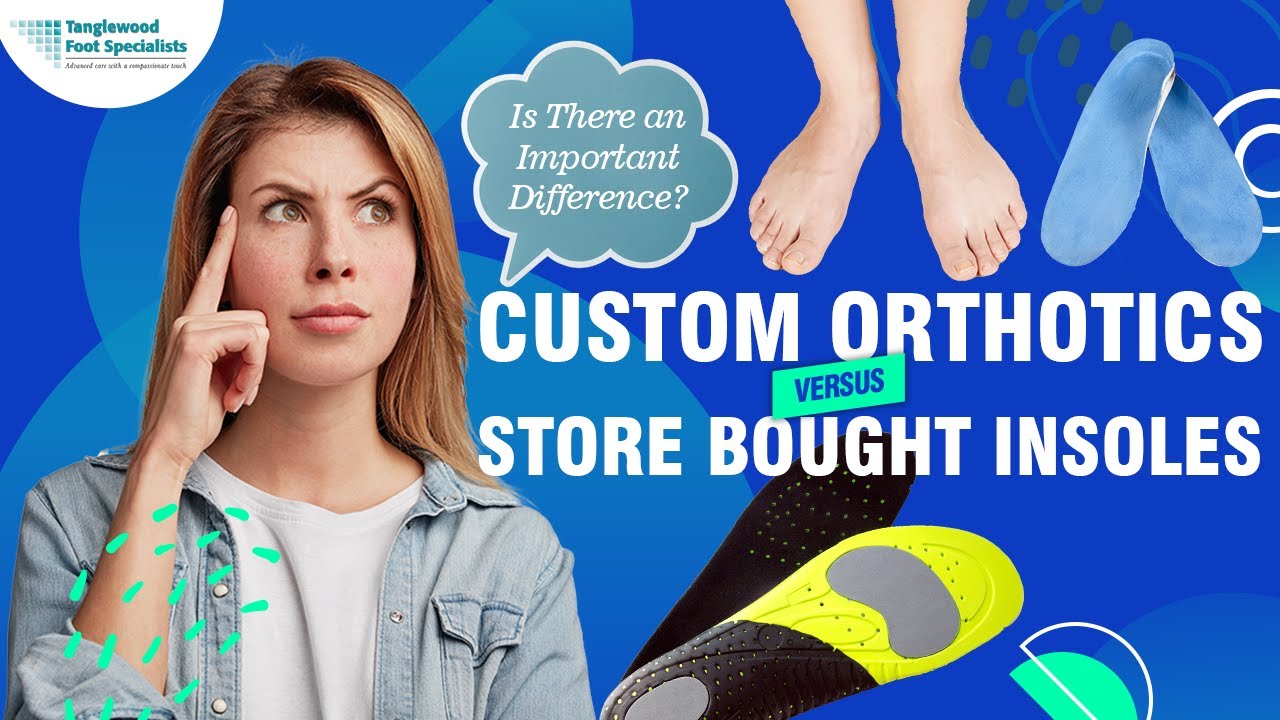
A custom orthotic is a prescription medical device fabricated from a 3D mold of your specific foot, prescribed by a  podiatrist after a full gait and biomechanical evaluation — the science of how your body moves when you walk, run, or stand, and how your foot, ankle, knee, hip, and back all communicate with every step. An OTC insole is a mass-produced insert built for an average foot. Both go in your shoe. That's where the similarity ends.
Here's what most people don't realize — the word "custom" has been hijacked by online retailers who ship you a foam kit with no evaluation behind it. You step on a mat, they mail you an insert, and somewhere in the packaging it says "custom-made for you." That's not custom. That's a prefabricated insert in a prettier box.
A genuine custom orthotic starts with a biomechanical exam, a gait analysis, and a 3D digital scan or foam cast of your foot. The shell material, arch height, heel cup depth, and posting angles are all selected based on your specific diagnosis and activity level.
Think of it like eyeglasses. You could grab a pair of reading glasses off a pharmacy rack and see better than you did before — and for mild, occasional blur, that might be fine. But if your vision has a specific prescription, those readers aren't correcting your optics.
They're approximating them. A custom orthotic works the same way: it compensates for your biomechanics, not the average person's guess at what your foot needs.
One more distinction worth understanding: there are two types of custom orthotics. A functional orthotic is designed to correct abnormal motion — overpronation, supination, gait faults that load your joints the wrong way. An accommodative orthotic offloads pressure from painful areas rather than correcting movement, which is why it's standard in diabetic foot care where the priority is protecting tissue from breakdown, not changing mechanics. Your diagnosis determines which type you actually need.
Why OTC Insoles Work for Some People — and Fail Others
OTC insoles aren't a bad product. For mild, intermittent discomfort — occasional long days on your feet, new shoes that  need breaking in, general fatigue in a foot with no structural problem — a quality insole can take the edge off and get you through. That's a real use case, and I'd never talk you out of it if that's all you're dealing with.
The breakdown happens when pain is driven by a mechanical fault. Overpronation — when your foot rolls too far inward with each step, causing the arch to collapse and stacking abnormal stress on your heel, knee, and hip — doesn't respond to cushioning. Neither does a high arch, a leg length difference, progressive plantar fasciitis, or Achilles tightness pulling your heel mechanics out of alignment.
In those cases, an OTC insole treats what you feel. It doesn't touch what's causing it.
There's also a meaningful quality spectrum worth knowing. A semi-rigid Superfeet or Powerstep from a running store is genuinely better than a drugstore gel insert — it provides some arch support rather than just cushioning, and cushioning and biomechanical support are different things. Research published in the Archives of Internal Medicine found that while both OTC and custom orthotics reduced plantar fasciitis pain short-term, custom devices produced superior outcomes at 12 months for patients with structural mechanical faults. But even the best OTC insole lasts 6–12 months before the materials compress and lose function, often without you noticing.
Custom orthotics last 2–5 years. The per-year cost gap closes faster than most people expect.
Here's what most people don't realize: the problem isn't that you chose an insole over a custom orthotic. The problem is that nobody helped you figure out which option your mechanics actually need. The pressure-map scan at a running store shows where you load your foot — not why, and not what to do about the underlying mechanics driving that load pattern. That distinction is exactly what a chronic heel pain evaluation is designed to answer.
The Truth About Whether Orthotics Will Weaken Your Feet
This comes up constantly. The concern makes intuitive sense: if something is doing the work, don't your muscles stop doing it? The short answer is no — and the reason matters.
Custom orthotics don't immobilize your foot. They correct the mechanical environment your muscles are working in. When your foot is pronating excessively, certain muscles are chronically overloaded compensating for that fault while others go underused.
An orthotic corrects the position — so the right muscles do the right work, instead of the wrong muscles doing twice as much. That's not dependence. That's correction.
The "crutch" analogy people reach for doesn't hold up. A crutch replaces a function you'd otherwise perform. An orthotic adjusts the position in which you perform that function while you're actively moving.
Different mechanism entirely. You'll likely need to wear them long-term for structural conditions — not because your muscles weakened, but because the underlying mechanics haven't changed. Eyeglasses don't weaken your eyes. You still wear them.
Which Conditions Actually Need Custom Orthotics?
Let me be direct about this — because a lot of podiatry content turns this into a list that quietly pushes everyone  toward the most expensive option. I'd rather give you the honest breakdown.
An OTC insole is a reasonable first step for mild arch fatigue from occasional long days on your feet, general soreness from new shoes during break-in, or short-term discomfort in a foot that's structurally fine. If that's your situation, start there. Try a semi-rigid Superfeet or Powerstep from a running store — not a drugstore gel insert — and give it a consistent 2–4 week trial before declaring failure.
But a custom orthotic is the right treatment — not just the preferred one — in several specific situations. Flat feet that are generating knee, hip, or low back symptoms are a clear signal: think of your lower extremity like a chain. When one link is off-position, every link above it compensates, and those compensations accumulate in your joints with every step. High arches with recurring ankle sprains or stress fractures, leg length discrepancy causing a compensating gait pattern, Morton's neuroma requiring metatarsal offloading, and metatarsalgia unresponsive to cushioning all fall into this category as well.
Diabetic foot with any degree of neuropathy is a clinical necessity, not a preference. Pressure redistribution via a custom accommodative orthotic is a cornerstone of amputation prevention — not an upgrade. A review in the Journal of Clinical Medicine confirms that prescription custom orthotics demonstrate clinically meaningful superiority over OTC devices for patients with structural deformity, diabetic neuropathy, and rheumatoid arthritis. And for Houston runners dealing with recurring injuries, the threshold is even clearer: if your mechanics are loading the wrong structures, training volume just accelerates the damage.
In my Tanglewood practice, I see this play out constantly — runners logging miles on Memorial Park trails, people spending ten hours on the concrete floors of the Texas Medical Center, and Galleria-area professionals walking miles of hard tile in dress shoes with zero mechanical support. The surfaces Houston demands of your feet are unforgiving.
After treating thousands of patients, I can tell you the clearest signal that you need a custom orthotic: you've had pain for more than six weeks, you've already tried a decent OTC insole consistently, and you're still hurting. That's not a willpower problem. That's a biomechanics problem.
How a Houston Podiatrist Treats Foot Pain — From Insoles to Advanced Options
My job isn't to sell you the most expensive option. It's to match you with the right one. Sometimes that's a $40 running store insole and better shoes. Sometimes it's a custom orthotic.
And sometimes — when the tissue itself has been damaged too long for mechanics alone to fix — it's something most people didn't know existed.
Start Here — Footwear and Quality OTC Insoles
Before anything else, I want to know what shoes you're living in. Shoe selection by foot type matters more than most people realize: stability or motion-control shoes for overpronators, neutral cushioning for high-arched feet, and structured support for flat feet. Getting this wrong means even a good insole is fighting uphill.
For OTC insoles, I recommend Superfeet, Powerstep, Spenco, or RediThotics — not the Dr. Scholl's scanner kiosk. Give the insole a consistent 2–4 week trial before drawing any conclusions. And check your athletic shoes: most people are walking on dead foam without knowing it.
Replace them every 300–500 miles, regardless of how the upper looks.
The escalation signal at this level is clear — if your pain persists beyond 4 weeks of proper shoe selection plus consistent OTC insole use, or if morning pain is the first sensation you have when you get out of bed, you've moved past what footwear changes can address on their own.
The Custom Orthotic — What the Process Actually Looks Like
 The evaluation starts with watching you walk. Not for theater — because your gait tells me things your foot shape alone never could. A full assessment covers lower extremity alignment, range-of-motion testing, pressure mapping, and a 3D digital scan that captures your foot geometry precisely. From that, I select the shell material based on your diagnosis and activity level, and build in the specific posting, arch height, heel cup depth, and modifications your mechanics require.
The cash price is $700 for a primary pair; additional pairs are $350 each, which is worth considering if you rotate between work, athletic, and dress shoes — same prescription, different demands. Most people notice real improvement within 2–4 weeks and are fully accommodated by 6–8 weeks. The lifespan is 2–5 years versus 6–12 months for OTC insoles.
Run the per-year math and the gap is smaller than the sticker price suggests. A digital gait analysis is where that evaluation starts.
The numbers are clear: conservative care including custom orthotics resolves approximately 95% of plantar fasciitis cases without surgery — but that outcome depends on the right device, not just any device. According to clinical practice guidelines in the Journal of Foot and Ankle Surgery, structured conservative care including orthotic therapy is the recommended first-line treatment before any surgical consideration. The distinction matters, and orthotics for plantar fasciitis work best when fabricated from a proper biomechanical evaluation, not a mail-in kit.
When Orthotics Aren't Enough — The Third Option
For chronic cases — pain lasting 6 months or more — the tissue itself has often degenerated. Collagen structure breaks down. The body's healing response goes dormant.
At that point, correcting your mechanics helps — but it won't rebuild tissue that's already broken down. The tissue needs a biological signal to restart the repair process. This is what I call the Third Option — the treatment path that exists between "keep trying conservative care" and "schedule surgery." It's the option most people didn't know existed.
Shockwave therapy delivers acoustic pressure waves into the damaged tissue, stimulating the body's healing response in tissue that's gone quiet. Think of it like lawn aeration — creating pathways for healing to penetrate where it couldn't before. Clinical research in Foot & Ankle International documents an 82% success rate for chronic plantar fasciitis unresponsive to conventional care. The cash price is $300 per session or $750 for a package of three.
PRP injection takes a small blood draw, runs it through a centrifuge to concentrate your own growth factors, and injects that directly into the damaged tissue. A systematic review in the Journal of Foot and Ankle Surgery found PRP achieves a 70–80% success rate for chronic tendinopathy where conventional treatment has failed. Cash price is $850.
When I combine PRP with shockwave — what I think of as the Seeds and Soil protocol — PRP delivers the healing ingredients while shockwave prepares the tissue environment to activate them. Combined, the success rate for chronic cases unresponsive to conventional care climbs to 85–95%. You can read more about all of this under regenerative medicine options.
What About Surgery?
Look, I know surgery sounds like the last thing you want to think about when you started out just looking for a better insole. And for the overwhelming majority of you, it's not where this ends. Roughly 95% of foot pain cases that bring people to search this topic never reach the operating room.
When surgery is genuinely indicated — for structural conditions that haven't responded to conservative and regenerative care — plantar fasciotomy carries a 70–80% success rate when appropriately selected. But that's a conversation we'd only be having after exhausting every option above it. Foot surgery is the last resort, not the default.
Not Sure What You Need? That's Exactly Why You Come In.
I'll evaluate your mechanics, review your history, and give you a straight answer — not a sales pitch.
Schedule Your Evaluation →
What Happens at an Orthotics Evaluation in Houston
When you come in, I'll start by asking what you're trying to get back to — not just what hurts. That distinction matters. A runner logging 30 miles a week has different mechanical demands than someone who needs to stand through a hospital shift, and the orthotic I build needs to serve the life you're actually living, not a generic version of it.
From there, I'll watch you walk. I'm looking at your stride pattern, how your foot strikes the ground, where your heel lifts, how your arch responds under load, and how your body compensates from the ankle up. After gait observation, I'll do a full lower extremity exam — range-of-motion testing at the ankle and subtalar joint, alignment assessment from hip to toe, and a pressure evaluation to map where you're loading and where you're not. The whole evaluation typically runs about an hour for a new patient.
Then we'll talk through what I found — in plain language, not clinical shorthand. If a custom orthotic is what your mechanics need, I'll tell you specifically why: which fault we're correcting, what shell material and modifications are going into the device, and what you should expect to feel in the first few weeks. The scan takes a few minutes. Fabrication typically runs about two weeks, and I'll see you back at four to six weeks to assess fit and make any adjustments at no charge.
Here's what I want you to understand before you come in: if footwear changes and a quality OTC insole will do the job, I'll tell you that — and I'll tell you exactly what to buy. Either way, I need to see you. Because a two-minute conversation with a machine at a pharmacy kiosk isn't a biomechanical evaluation, and the difference between getting this right and getting it close can be years of chronic pain.
Dr. Andrew Schneider has been having this conversation in Houston for over 25 years. Come in. Let's schedule your evaluation and give you a real answer.
Making Your Custom Orthotics Last — and Knowing When to Replace Them
Custom orthotics are a durable investment, but they're not indefinite. Most pairs last 2–5 years depending on your activity level, body weight, and the shell material selected for your diagnosis. The clearest replacement signals are visible wear on the shell itself, or a return of pain that was previously well-managed — your body will usually tell you before your eyes do.
A few maintenance habits make a real difference. Rotate between two pairs of shoes rather than wearing the same pair daily — it lets each pair recover and distributes load variation across your stride. Remove the orthotics when you're not weight-bearing.
Spot-clean the cover with a damp cloth; don't submerge them. If squeaking develops between the orthotic and shoe lining, a light dusting of talcum powder or cornstarch solves it.
If your weight changes significantly, you go through pregnancy, or your gait changes after surgery, come in for a reassessment. The orthotic was built for your mechanics at a specific moment. Major body changes mean your mechanics may have shifted enough to warrant a new prescription.
Additional pairs at $350 are worth considering if you rotate between work, athletic, and dress shoes — different surfaces, different demands, same prescription accuracy. For long-term planning, non-surgical treatment options remain the backbone of how I manage most foot and ankle conditions.