What Is Regenerative Medicine in Podiatry?
Regenerative medicine for foot pain refers to a group of treatments that use your body's own biological healing mechanisms — or precisely targeted physical stimuli — to repair damaged tendons, ligaments, and soft tissue. Rather than masking pain with medication or removing tissue surgically, regenerative therapies restore the tissue itself. Common examples include platelet-rich plasma (PRP) — a concentrated solution made from your own blood — shockwave therapy, Class IV laser, red light therapy, and oral peptides such as BPC-157.
Here's what most people don't realize: most chronic foot pain isn't caused by a dramatic injury. It's caused by tissue that started healing and then stopped. Your body sent the repair crew, they started the job, and for reasons that often  involve poor blood supply or repetitive stress, the work stalled. Doctors call this a failed healing response — tissue locked in a loop of low-grade inflammation that never progresses to actual repair.
It's like having a construction crew that started a renovation and never finished it. The materials are there, the damage is visible, but the work just stopped. Regenerative medicine is how we get them back on the job — by signaling your body to release growth factors (specialized proteins that tell cells to wake up and rebuild tissue) directly into the damaged area.
The Myth That's Keeping You in Pain
I hear this constantly: "If regenerative medicine were really proven, my insurance would cover it." It sounds logical. But insurance coverage and clinical evidence are completely separate things — and conflating them is costing people years of unnecessary pain.
Reimbursement decisions typically lag behind published research by seven to ten years — that's not a conspiracy, it's just how insurance systems work. PRP has more than 20 years of peer-reviewed research across orthopedics and sports medicine. Shockwave therapy carries a well-documented success rate exceeding 80% for plantar fasciitis and Achilles tendinopathy across multiple meta-analyses.<sup>[1,2]</sup> These aren't experimental options — they're just not yet profitable enough for insurers to reimburse.
Here's the thing about the cost math: when you factor in 12 months of co-pays, two or three rounds of cortisone injections, lost productivity, and the much larger bill that comes with surgery and post-surgical rehab, most people find that a $750–$850 regenerative protocol is genuinely more cost-effective. Insurance covers what's cheapest for the insurer. That's not the same as what works best for you.
What Conditions Does Regenerative Medicine Treat?
I use regenerative medicine most often for conditions that sit in that frustrating middle zone — too chronic to respond  to stretching and ice, not bad enough yet to clearly require surgery. If you've had symptoms for at least three to six months and tried at least one round of conservative care, you're likely in the group that responds best.
The conditions I treat most frequently include chronic heel pain and plantar fasciitis — especially cases that have dragged on for more than three months — Achilles tendinopathy at both the insertion point and mid-portion, and chronic tendon conditions like peroneal tendonitis and posterior tibial tendon dysfunction. I also use regenerative protocols for running and overuse injuries, stress injuries, and early-to-moderate foot and ankle arthritis where joint degeneration hasn't reached the point of no return.
In Houston, I see this pattern constantly — runners training on the Memorial Park loop push through Achilles pain for weeks because they don't want to stop. People on their feet all day at the Texas Medical Center develop plantar fasciitis that never fully resolves because they can't offload the way recovery requires. The common thread is always the same: tissue that started healing and stalled.
I won't promise regenerative medicine works for everyone — it doesn't, and I'll tell you that straight. If you have an open wound that isn't healing, sudden sharp pain with an inability to bear weight, or numbness and color changes in a diabetic foot, those signs need immediate evaluation before anything else. But for the broad category of chronic musculoskeletal conditions that haven't responded to conservative care? This is where the conversation gets interesting.
How a Houston Podiatrist Treats Chronic Foot and Ankle Pain with Regenerative Medicine
In my practice, I don't start with the most advanced treatment and work backward. I start where it makes sense for your specific situation, and I move up only when the level below it has genuinely been given a fair shot. What that looks like in practice is a five-level progression I use for almost every chronic musculoskeletal case I see.
Lifestyle Changes
Sometimes the first move is the simplest one — and you can make it before you ever walk through my door. Swapping high-impact activity like running on concrete for lower-impact options like pool walking or cycling gives inflamed tissue a chance to breathe. Worn-out shoes with no medial support are a primary driver of chronic tendon overload, and most people have no idea how quickly a shoe loses its integrity. I also look at diet — reducing processed carbohydrates and increasing omega-3 intake lowers your body's baseline inflammation level, which matters more than most people expect.
Lifestyle changes alone rarely resolve an established tendinopathy. But they create the biological conditions where everything else works better. Expect 2–4 weeks of reduced symptoms; don't expect them to repair damaged tissue on their own.
At-Home Care
There's a real difference between what works and what just feels like you're doing something. Targeted calf stretching — the gastrocnemius and soleus separately, using both the straight-leg and bent-knee wall stretch — directly reduces tension on the plantar fascia and Achilles. Eccentric heel drops on a step (controlled lowering, 3 sets of 15 reps) are the most evidence-supported self-care technique for tendinopathy that exists. Night splints for fascial conditions keep the foot in a slightly stretched position while you sleep, which breaks the morning re-tear cycle that keeps so many people stuck.
What doesn't work as well as people think: generic icing provides temporary relief but doesn't drive healing. And over-the-counter insoles lose their support faster than most people realize — typically within 60 days of regular use.
The honest limitation of at-home care is that it can't address the structural reason the tissue became chronically injured — gait mechanics, pronation, limb length discrepancy — and it can't restart a failed healing response. If you're still hurting after 3–4 weeks of consistent effort, or the pain is interfering with work or daily function, it's time to come in.
Conservative In-Office Care
When at-home care isn't enough, there are two in-office options I reach for first — and they work through completely different mechanisms.
Think of custom orthotics that address the root cause like eyeglasses for your feet. While you're wearing them, your mechanics are corrected. Take them off, and that correction goes away — just like removing glasses. They don't cure the underlying condition, but they prevent the mechanical stress that keeps reinjuring tissue that's trying to heal.
I make them from a 3D scan after a full biomechanical exam and gait analysis, so they're built around what your foot actually does — not a generic arch shape. Cost: $700.
Cortisone injections ($120) do something different. They deliver a powerful anti-inflammatory directly into the pain site, which can provide 4–12 weeks of meaningful relief — enough to break a pain cycle so you can tolerate stretching and rehab. But whether cortisone shots make sense for your situation depends on your history.
What cortisone doesn't do is heal tissue. The underlying damage remains, and repeated injections — more than two or three over time — can actually weaken tendon and fascial tissue. I'll always tell you that tradeoff up front. For mild-to-moderate chronic presentations, conservative care resolves symptoms in roughly 50–70% of cases over 3–6 months.
Advanced Regenerative Medicine — The Third Option
This is the level most Houston podiatrists don't offer. I invested in this technology because I was watching people go from conservative care straight to surgery when a better path was available. These aren't experimental treatments — they're evidence-based options that simply don't fit the insurance reimbursement model yet.
Shockwave Therapy — $300/session · $750 for 3-session package
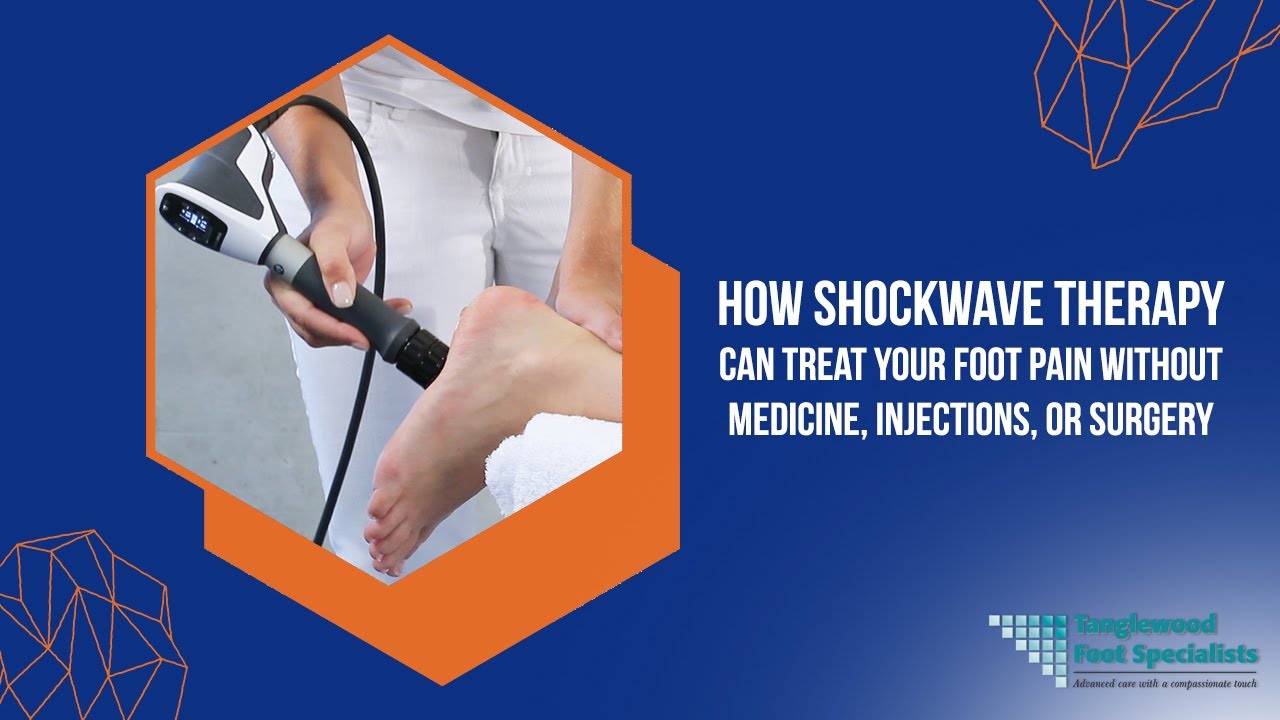
 Think of how shockwave therapy works for chronic tendon pain like aerating a lawn. Acoustic pressure waves punch small channels into compacted, scarred tissue — channels that attract blood flow, break up calcifications, and signal your body to release its own growth factors into an area that had gone dormant. Sessions run about 15 minutes. You'll feel a tapping sensation, and some soreness for 24 hours afterward is normal and actually a good sign.
Standard protocol is 3 sessions, once weekly. Peer-reviewed meta-analyses confirm ESWT significantly outperforms placebo for pain relief and tissue remodeling in plantar fasciitis and Achilles tendinopathy.<sup>[1,2]</sup> I use shockwave on my own heel pain — and that's not something I say lightly.
PRP (Platelet-Rich Plasma) — $850
PRP therapy for chronic foot pain is, as I always say, liquid gold for healing. I draw a small amount of your blood — the  same process as a routine lab draw — spin it in a centrifuge to concentrate the platelet layer, and inject that solution precisely into the damaged tissue, usually with ultrasound guidance to confirm placement. Platelets carry growth factors — proteins stored in structures called alpha granules — that act as chemical messengers telling your body to send its full repair response to the injury site.
Unlike cortisone, which silences inflammation temporarily, PRP drives actual tissue repair. A 2024 meta-analysis found PRP produced greater pain reduction than shockwave therapy alone for chronic plantar fasciitis, with significant improvements in pain scores and plantar fascia thickness.<sup>[3]</sup> A separate systematic review of Achilles tendinopathy found roughly 85% of people treated with PRP returned to activity, with 72% reporting meaningful satisfaction with outcomes.<sup>[4]</sup> Results build over 3–6 months as tissue remodels.
The Combined Protocol — PRP + Shockwave
The combined regenerative medicine protocol is the most powerful option I offer. PRP delivers the seeds — concentrated growth factors your body needs to rebuild damaged tissue. Shockwave prepares the soil — creating the optimal biological environment for those seeds to take root. The sequence matters: PRP injection first, then shockwave sessions beginning a few days later, once weekly for three weeks.
That's the ceiling neither treatment reaches alone. It's the reason I call this the Third Option — and it genuinely changes the math on whether surgery is necessary.
Remy Class IV Laser — $97/session · $497 for 6-session package
Remy Class IV laser therapy delivers focused light energy at a wavelength that penetrates deep into soft tissue, stimulating cellular energy production and accelerating repair at the cellular level. No needles, no downtime. It works well as a standalone option for milder presentations and as an add-on to shockwave or PRP for people who want every advantage.
Red Light Therapy — $39/session · $180 for 6-session package
Red light therapy for foot and ankle pain is lower-intensity photobiomodulation — light at specific wavelengths that stimulates the mitochondria in damaged cells and gives them a metabolic boost. Think of it as a recharge for tissue that's running low. I use it for support between more intensive sessions, or for people who aren't yet candidates for shockwave or PRP and want to keep progress moving.
Oral BPC-157 Peptides
BPC-157 peptide therapy for healing support uses a short chain of amino acids — a peptide found naturally in the stomach — taken orally to support tendon-to-bone healing, promote collagen synthesis, and reduce systemic inflammation.<sup>[5]</sup> I use it as a complement to the above protocols, particularly for connective tissue injuries where we want systemic support working alongside localized treatment.
Most insurance plans, including Medicare, don't cover regenerative therapies — these are cash-pay. But when you factor in months of co-pays, repeated cortisone injections, and the much larger bill that comes with surgery and post-surgical rehab, most people find a $750–$850 regenerative protocol is more cost-effective than it looks on paper.
Surgery — When It's Truly Necessary
Look, I know surgery sounds scary. But if we've done everything right and you're in the 5–10% of people whose condition genuinely requires it, modern podiatric procedures are faster to recover from than most people imagine. I'd rather show you every option available before we ever get to that conversation — and for the vast majority of people, we never do.
For something like an endoscopic plantar fascia release, the realistic recovery looks like this: weeks one and two in a surgical boot managing swelling; weeks three through six transitioning to supportive footwear and starting range-of-motion work; months two and three back to normal daily activity; months three through six cleared for high-demand activity, typically with custom orthotics to protect the surgical correction. Success rate for appropriately selected candidates: 70–90%. And well over 90% of people avoid surgery entirely when the treatment progression above is properly followed.
Ready to find out if regenerative medicine is right for you? Call 713-785-7881 or request your appointment online.
What to Expect at Your First Appointment
When you come in, I'll start by actually listening — not just to where it hurts, but to how long it's been going on, what you've already tried, and what you're trying to get back to. That last part matters more than most people expect. Whether your goal is running the Memorial Park loop again, standing through a full shift without pain, or just walking to your car without dreading the first few steps — that goal shapes every recommendation I make.
From there, I'll do a full biomechanical evaluation: watching how you stand and walk, noting where your body is compensating, checking range of motion in your ankle and calf. For most chronic tendon and fascial conditions, I'll use diagnostic ultrasound right here in the office to get a real-time image of the damaged tissue — this shows me exactly what we're dealing with and rules out things like a partial tendon tear that would change the plan entirely. If I need to see bone structure, we can do digital X-rays the same day.
My goal isn't to sell you on any particular treatment. It's to give you an honest picture of where you are, what's driving the problem, and what your realistic options are — with timelines and costs for each. I won't judge you for waiting as long as you did. Either way, I need to see you to give you a real answer about what's possible for your situation.
Most people leave their first visit with a clear plan — not "let's wait and see." If you're a candidate for regenerative care, we can often begin that same visit or schedule it within the week. Dr. Andrew Schneider has spent over 25 years in this practice building a reputation for telling people exactly what they need to hear — not what's easiest to say. That's where we'll start.