What Is Plantar Fasciitis? (Understanding Your Heel Pain)
 When you're dealing with that stabbing heel pain, you're likely experiencing plantar fasciitis—and before your eyes glaze over at the medical term, let me explain what that actually means.
The plantar fascia is that thick band of tissue that runs along the bottom of your foot from your heel to your toes. Think of it like a bowstring that supports your arch and absorbs shock when you walk. It's designed to handle tremendous stress, but it has limits.
Here's what's actually happening when you have plantar fasciitis. This tissue becomes inflamed and develops tiny tears—microtears that accumulate faster than your body can repair them. Your foot is essentially breaking down faster than it can heal itself. And here's the kicker: the plantar fascia has relatively poor blood supply compared to other tissues in your body.
That poor blood flow is why plantar fasciitis becomes such a chronic, stubborn condition. Without good circulation, your body struggles to deliver the healing factors that damaged tissue needs. It's not that your body isn't trying to heal—it's that the repair crews can't get there efficiently.
Every step you take puts about 1.2 times your body weight on that tissue. If you weigh 150 pounds, that's 180 pounds of force with each step. Multiply that by the 10,000 steps most people take in a day, and you start to understand why this doesn't just "go away" on its own. You're asking a poorly-supplied, overworked tissue to heal itself while you continue stressing it thousands of times a day.
Why Does It Hurt Worst in the Morning?
This is the question I hear most often, and it's the key to understanding why plantar fasciitis is so frustrating to deal with.
Here's what's happening while you sleep. Your body tries to heal the damaged tissue—that's what it does. As part of that healing process, the plantar fascia naturally contracts and shortens. This is completely normal. When you're lying down with your foot relaxed, there's no tension pulling on it, so the tissue naturally goes into its resting position.
But then morning comes. You swing your legs out of bed, put your feet on the floor, and take those first steps. That shortened, partially-healed tissue suddenly gets stretched again—and all that repair work your body did overnight gets torn apart. That's the stabbing pain you feel. It's like taking a rubber band that's been sitting in a drawer, and suddenly stretching it to its limit.
We call this "post-static dyskinesia" in medical terms, but what it really means is pain after staying still. And the same thing happens if you've been sitting for a while—at your desk, in the car, at a restaurant. You stand up and those first few steps hurt like crazy. Then, as you move around, the tissue warms up and stretches out, and the pain eases. You might even forget about it for a while.
By the end of the day, though? It's back with a vengeance. You've been on your feet for hours, and that tissue is exhausted and inflamed all over again. The impact forces have been accumulating, the microtears are getting worse, and your plantar fascia is screaming for relief.
This pattern—worst in the morning, better after moving around, worse again after prolonged activity—is the hallmark of plantar fasciitis. If you're experiencing this exact cycle, you're not imagining it. Your body is stuck in a loop where it can't heal faster than you're re-injuring it every single day.
Common Causes and Risk Factors
Your plantar fascia didn't get inflamed because you walked too much one day or wore the wrong shoes once. This develops over time, usually from a combination of factors that add up. In our Houston podiatry practice, I see these patterns over and over again.
Biomechanical Issues (The Biggest Culprit)
This is the foundation of most plantar fasciitis cases. If your foot mechanics aren't ideal—whether you overpronate (roll inward), have high arches or flat feet—your plantar fascia takes on more stress than it's designed to handle with every single step you take.
Think of it like a car with poor alignment. The tires wear out faster because the forces aren't distributed evenly. Same thing happens with your feet. When your foot rolls too far inward with each step, the plantar fascia has to work overtime to support your arch. Do that 10,000 times a day, and the tissue breaks down.
What most people don't realize is that custom orthotics can correct these biomechanical issues by redistributing the forces across your foot. But we'll get to that in the treatment section.
Activity Changes
 I see this a lot with runners who suddenly increase their mileage, or people who start a new job that requires standing all day. Your plantar fascia can adapt to gradual increases in stress—that's how tissues get stronger. But sudden changes overwhelm its capacity to adapt.
Here's what happens: you go from running 15 miles a week to 30 miles a week in the span of two weeks because you're training for a race. Or you go from a desk job to a teaching position where you're on your feet six hours a day. Your plantar fascia doesn't have time to strengthen in response to the new demands, so it starts breaking down instead.
Footwear Problems
Those cute flats with zero support? The worn-out running shoes you've been meaning to replace for six months? Walking barefoot on hard floors "because it feels good"? All of these put excessive strain on your plantar fascia.
And here's something specific to Houston: in our heat and humidity, the adhesives in shoes break down faster than in drier climates. That means your running shoes might look fine on the outside, but the midsole cushioning has already compressed and lost its shock-absorbing ability. I tell patients to check their athletic shoes every 4-6 months, not just when they look worn.
Tight Calves and Achilles Tendon
 When your calf muscles and Achilles tendon are tight, they limit your ankle's range of motion. To compensate, your foot has to work harder with every step—and that extra work falls largely on the plantar fascia.
This is especially common in people who wear high heels regularly. Over time, wearing heels actually shortens your Achilles tendon. Then when you try to wear flat shoes, your plantar fascia has to compensate for that loss of flexibility. It's like asking one employee to do the work of two people—eventually, they burn out.
Weight and Age (No Judgment, Just Facts)
I'm going to be honest with you here, without any judgment. Carrying extra weight increases the load on your plantar fascia with every step. That's simple physics. If you're 40 pounds heavier than you were five years ago, your plantar fascia is absorbing 40 pounds more force with each step, thousands of times a day.
And as we age, the fat pad in our heel naturally thins out, providing less cushioning. A 25-year-old has a thick, resilient fat pad that absorbs shock. A 55-year-old? That fat pad has compressed over decades of use. Same impact forces, less protection.
These aren't things you need to feel bad about—they're just factors we need to account for in treatment. And honestly? Addressing your heel pain might make it easier to exercise and lose weight if that's a goal, because you won't be in pain with every step.
Standing Occupations
Teachers, nurses, retail workers, chefs, warehouse employees—anyone who spends hours on hard surfaces is at significantly higher risk. The ground reactive force (the ground pushing back against every step) combined with prolonged standing creates the perfect storm for plantar fascia breakdown.
What makes it worse is that most commercial and industrial floors are concrete or tile—the hardest possible surfaces. Your plantar fascia is absorbing full impact with zero give from the ground. It's like the difference between jumping onto a gymnastics mat versus jumping onto concrete. Same jump, but one surface tries to kill your joints. Athletes and active people face similar challenges with sports-related foot injuries from repetitive impact.
Heel Spurs: Separating Fact from Fiction
 Let me let you in on something: most people who come to my office are convinced their heel pain is caused by a heel spur. They've heard about them, maybe even had an X-ray that showed one, and they're sure that's the problem.
Here's the truth—heel spurs are the result of plantar fasciitis, not the cause. The spur forms where the plantar fascia attaches to your heel bone, as a response to the chronic pulling and inflammation. It's your body's attempt to reinforce a stressed area. Similar to how hammertoes develop from chronic muscle imbalances, spurs form from chronic mechanical stress.
And here's the interesting part: about half of plantar fasciitis patients have heel spurs, and half don't. The presence or absence of a spur doesn't determine your pain level or your prognosis. I've seen patients with large spurs who have zero pain, and patients with no spur at all who can barely walk.
The myth that "the spur is stabbing into my foot from inside" just isn't accurate. Your heel has a thick fat pad that cushions the bone—the spur isn't poking through anything. In rare cases where heel spurs do cause direct pain, it's usually because that protective fat pad has worn away (which is a different problem that requires different treatment).
This is why surgically removing a heel spur doesn't always fix the pain. If you don't address the biomechanical issues and inflammation that caused the spur in the first place, the pain persists—or comes back.
Why Rest and Ice Alone Don't Work
You've done everything right. You've stretched, iced, rested, and bought new shoes. Maybe you even gave up running or took a break from your regular workouts. But here's what's frustrating—the pain came back as soon as you tried to return to normal activity.
Here's the thing: ice and rest treat the symptom, not the cause. Ice reduces inflammation temporarily, which makes you feel better. Rest allows the tissue to calm down. Both of these are helpful—but they don't address the biomechanical forces that caused the problem in the first place.
Think about it this way: if your plantar fascia's breaking down because your foot overpronates with every step, icing it might reduce today's inflammation. But tomorrow, when you start walking again, your foot's still overpronating. The forces that caused the initial injury are still there.
This is why so many people get stuck in the frustrating cycle: feel better → resume activity → pain returns. You haven't re-injured it. You never fixed the underlying problem.
The same goes for those over-the-counter insoles. They're better than nothing, and about 30-40% of people get some relief from them. But they're not custom-fitted to YOUR foot mechanics. They're designed for an "average" foot that doesn't really exist.
Look, I get it. You tried to handle this yourself because you hoped it'd go away. You didn't want to deal with doctor's appointments or treatments or any of that. But what most people don't realize is that the longer you wait, the harder it becomes to treat. Chronic plantar fasciitis—cases that've been going on for six months or more—responds more slowly to treatment than acute cases caught early.
Houston Podiatrist Explains Plantar Fasciitis Treatment Options
So what actually works? Let me walk you through the treatment progression I use with patients. We always start with the least invasive options and only move to more aggressive treatments if needed. The good news is that most people find relief well before we get to surgery.
Lifestyle Changes (Start Here)
Sometimes, that's as simple as changing your shoes. If you're wearing shoes that squeeze your toes together, offer no arch support, or have worn-out cushioning, nothing else we do will be fully effective. Look for shoes with good arch support, adequate cushioning, and a heel-to-toe drop of about 4-8mm. Brands like Brooks, ASICS, and New Balance consistently make reliable options. The exact model matters less than the fit—your toes should have room to spread, your heel should be snug, and your arch should feel supported. In Houston's heat and humidity, shoe adhesives break down faster than in drier climates. Check your athletic shoes every 4-6 months, not just annually. If the tread is worn or the midsole feels compressed, it's time to replace them.
And here's a hard rule: stop walking barefoot. I know it feels good, especially on those cool tile floors first thing in the morning. But those first barefoot steps are when you're doing the most damage. Keep a pair of supportive sandals next to your bed and slip them on before your feet hit the floor.
If you're a runner or very active, you need to scale back—I know you don't want to hear that. Cut your mileage or activity level by about 50% while we're treating this. No hills, no speed work, nothing that aggravates the pain. Houston runners: avoid running on heated concrete during peak summer hours. The hard, hot surface increases impact stress on your already-inflamed plantar fascia. Early morning or evening runs on softer surfaces like the trails at Memorial Park or Buffalo Bayou are much easier on your feet.
At-Home Care
Now, for some of you, these swaps may be enough to reduce pressure and allow your plantar fascia to heal. But if you've already made these changes and you're still hurting, here's what else you can do at home.
 Ice - Here's my favorite method: freeze a water bottle and roll your foot on it for 15 minutes, 3-4 times a day. This does double duty—the cold reduces inflammation, and the rolling massage helps work out tension in the tissue. But remember: ice treats the symptom, not the cause. It's helpful for managing pain, but it's not a standalone solution.
Stretching - This is critical, and timing matters more than you'd think. You need to stretch your calf muscles and plantar fascia BEFORE you take your first steps in the morning—not after. Here's what I tell patients to do: before you get out of bed, flex your foot by pulling your toes toward your shin. Hold for 30 seconds, repeat three times. This stretches the plantar fascia while it's still shortened from sleep, so when you stand up, you're not tearing that repair work apart. During the day, calf stretches help tremendously. Stand facing a wall, put your hands on the wall, and step one foot back. Keep that back heel on the ground and lean forward until you feel a stretch in your calf. Hold 30 seconds, repeat three times, do this 3-4 times a day.
Night Splints - These keep your foot flexed while you sleep, preventing that overnight contraction. They're about 70-80% effective—but here's the catch: they're uncomfortable. Most patients hate them. You might wake up feeling like you're wearing a ski boot to bed. But if your morning pain is severe, they're worth trying.
Over-the-Counter Insoles - Products like Superfeet and Powerstep are better than drugstore inserts, and some people get relief from them. But they're not custom-fitted to your specific biomechanics, so their effectiveness is limited. About 30-40% of people find them helpful enough to stick with them. The other 60-70%? They need something more targeted.
Conservative In-Office Treatment
When that's not enough, we can take a more direct approach in the office.
Custom Orthotics - This is where we see real results. Custom orthotics address the root  cause of plantar fasciitis by correcting the biomechanical issues that created excessive stress on your plantar fascia in the first place.
Think of custom orthotics like eyeglasses for your feet. While I'm wearing my glasses, I can see. When I take them off, I can't. Orthotics work the same way—they compensate for your foot mechanics while you're wearing them. They don't permanently cure the underlying issue, but they allow your plantar fascia to heal and stay healthy as long as you use them.
Here's what makes them different from over-the-counter insoles: we take a 3D scan or mold of YOUR feet, analyze YOUR gait, and create devices specifically designed to address YOUR biomechanical issues. Whether you overpronate, have high arches, or have a leg length discrepancy, the orthotics are calibrated to your specific needs. About 75-80% of patients get significant relief from custom orthotics, usually within 2-3 weeks of consistent use. They typically cost $400-600, and they last 3-5 years with proper care—which works out to about 30 cents a day for pain relief.
Here's the catch: you have to actually wear them. I can't tell you how many patients come back after a month saying "they didn't work," and when I ask, they admit they only wore them a few times. Orthotics need to be worn consistently in any shoe you're walking in for more than 10 minutes.
Cortisone Injections - If you've been doing conservative treatment for 4-6 weeks without adequate improvement, a cortisone injection can help break the inflammatory cycle. Here's what to expect: I'll inject a corticosteroid directly into the most painful area of your heel. Within 24-48 hours, most patients experience significant pain relief that lasts anywhere from 6 weeks to 3 months. About 70% of patients get substantial relief.
The limitation: you can only have 2-3 cortisone injections per year in the same location. Repeated injections can weaken the tissue over time. So we use them strategically—to reduce inflammation enough that other treatments (like orthotics and stretching) can start working. If you're diabetic, we're more cautious with cortisone because it can temporarily raise blood sugar levels.
Physical Therapy and Strapping - Sometimes we'll tape or strap your foot to provide temporary support while the inflammation calms down. This helps take pressure off the plantar fascia and gives it a chance to rest. Physical therapy focuses on strengthening the muscles that support your arch and improving your overall foot mechanics. These approaches work best when combined with orthotics, not as standalone treatments.
Advanced Therapies
What's exciting is that we now have treatments that almost make surgery obsolete for heel pain. These regenerative therapies work by jumpstarting your body's natural healing process.
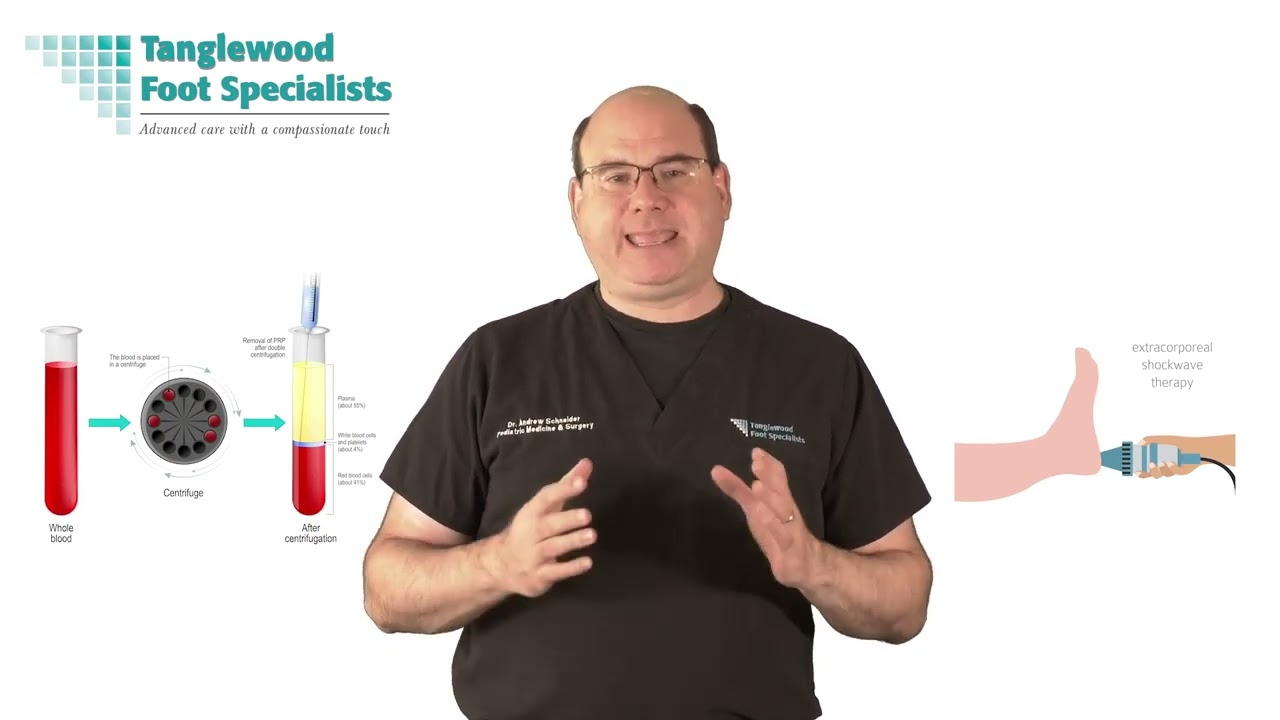
Shockwave Therapy - This is where things get interesting. Shockwave therapy uses  acoustic pressure waves to stimulate healing in damaged tissue. Despite the intimidating name, it's not electric shocks—it's sound waves.
Think of shockwave therapy like aerating a lawn. By creating small channels in compacted soil, you allow water, air, and nutrients to penetrate more deeply, resulting in healthier growth. Shockwave therapy does the same thing for your plantar fascia—it creates pathways for healing factors to reach the damaged tissue and jumpstarts your body's repair process.
Each treatment takes 10-15 minutes. You'll feel a tapping sensation as we deliver the pressure waves to your heel. We can adjust the intensity for your comfort—some mild discomfort during treatment actually indicates we're hitting the right spot. After treatment, some patients have mild soreness that resolves within 24 hours. Typically, I recommend once a week for three weeks. The success rate is impressive—more than 80% of patients experience significant pain relief after completing the full course of treatment. I've told patients that shockwave therapy almost makes surgery obsolete for heel pain, and I stand by that statement.
PRP (Platelet-Rich Plasma) Therapy - PRP therapy uses your own blood to accelerate  healing. Here's how it works: we draw a small amount of blood from your arm (similar to a routine blood test), spin it in a centrifuge to concentrate the platelets, and inject that concentrated plasma directly into your damaged plantar fascia. Platelets contain growth factors—proteins that signal your body to send healing cells to an injured area. By concentrating these platelets and injecting them precisely where they're needed, we deliver a powerful healing boost directly to damaged tissue.
The procedure takes about 30 minutes start to finish. Most patients describe mild discomfort during the injection, followed by some soreness for a day or two (which is normal—it means your body is responding). Here's the timeline: most patients begin to notice improvement within 2-4 weeks, with continued improvement over the following months. The full benefit might not be apparent until 3-6 months after treatment, but the results tend to be lasting. Success rate is about 75-85%. The drawback: most insurance doesn't cover PRP, so it's typically a cash-pay procedure ranging from $500-800.
Combined PRP + Shockwave - This is the most advanced non-surgical option we have, and it's where we see the highest success rates—85-95%. It's like planting seeds in a garden. PRP provides the seeds—the growth factors and healing signals that tell your body to repair damaged tissue. Shockwave therapy prepares the soil—it creates the optimal environment for those healing factors to work. Together, they create a powerful healing environment that can succeed where other treatments have failed.
We typically do the PRP injection first, then begin shockwave treatments within a few days, usually once a week for three weeks. This sequence allows us to introduce the healing factors first, then repeatedly stimulate them to maximize their effectiveness. This combined approach is what I recommend for patients with chronic plantar fasciitis (more than 6 months) who haven't responded adequately to conservative treatment but want to exhaust all options before considering surgery.
Surgery (When Necessary)
 Having said all that, some patients will need foot surgery to cure plantar fasciitis. Why is that the case? Some cases of plantar fasciitis are caused by factors that can't be addressed with conservative or regenerative treatment—severe biomechanical abnormalities, complete rupture of the plantar fascia, or cases where the tissue has deteriorated so much that it simply can't regenerate effectively.
But let me be clear: only about 5% of plantar fasciitis patients ever need surgery. We only consider it after you've tried conservative treatment for at least 9-12 months without adequate relief, and the pain is significantly affecting your quality of life.
The most common procedure is called a plantar fascia release. We make a small incision and partially release the plantar fascia where it attaches to the heel bone, reducing the tension. This is sometimes combined with removing any heel spur if present, though as I mentioned earlier, the spur isn't usually the main problem.
Look, I know that foot surgery sounds scary. But plantar fascia release is a straightforward procedure with a high success rate—70-90%—when done for the right reasons. It's typically performed as outpatient surgery, meaning you go home the same day. Most patients can bear weight on the foot immediately after surgery in a walking boot, without crutches.
Here's the recovery timeline:
Weeks 1-2: You'll be in a walking boot with limited weight-bearing. Most patients can walk with the boot, but you'll need to take it easy.
Weeks 3-6: Gradual transition to regular shoes as pain allows. Physical therapy usually starts around week 3-4.
Weeks 6-12: Progressive return to normal activities.
Months 4-6: Most patients can return to high-impact activities like running.
The stitches come out in about two weeks. Most of my surgical patients tell me they wish they'd done it sooner. But we don't get to that point unless we've genuinely exhausted other options.
If you've been dealing with heel pain for more than two weeks without improvement—or if it's getting worse despite your efforts—contact us for an immediate appointment at 713-785-7881 or request an appointment online. The sooner we figure out what's causing your pain, the faster we can get you back to walking without that stabbing sensation every morning.
What to Expect When You Come In
When you schedule an appointment for heel pain, here's exactly what happens—and I want you to know this upfront so there are no surprises.
I'll start by watching you walk. Gait analysis tells me a tremendous amount about how your feet are functioning—where you're putting pressure, how your foot rolls, whether one leg is longer than the other, how tight your calves are. This isn't just casual observation. I'm looking for specific biomechanical patterns that contribute to plantar fascia stress. I might ask you to walk on your toes, walk on your heels, or stand on one foot. These simple tests reveal a lot about muscle strength and joint function.
Then we'll do a thorough foot examination. I'll press on different areas of your heel and arch to find exactly where the pain is coming from—sometimes it's the classic spot where the plantar fascia attaches to your heel bone, but sometimes it's actually midfoot or involves multiple structures. I'll check the range of motion in your ankle and toes, feel for tight structures, and test your muscle strength. I'm looking for anything that might be contributing—tight Achilles tendon, weak intrinsic foot muscles, areas of thickened tissue.
Sometimes we'll take X-rays. Not because I think you have a fracture (though we do need to rule that out), but to see if there's a heel spur and to look at your overall bone structure. If your symptoms don't fit the typical pattern, or if I'm concerned about a complete tear in the plantar fascia, we might do an ultrasound or order an MRI. But for most straightforward cases of plantar fasciitis, the physical examination tells me what I need to know.
Then comes the important part: we talk about what's causing YOUR specific heel pain. Not generic heel pain—the unique combination of factors affecting your feet. Because the construction worker who's been on concrete for 20 years needs different treatment than the runner who ramped up mileage too fast, who needs different treatment than the teacher who stands all day in unsupportive shoes.
I'm going to ask you about your daily activities, your footwear, your exercise habits, your work environment. I want to know what you've already tried and how long you've been dealing with this. If it seems like you're just choosing the wrong shoes and overdoing activity, we might be able to fix this with orthotics and some modifications. But if we realize the source is more complex—severe biomechanical issues, failed conservative treatment, or factors that need more aggressive intervention—we'll talk through the progression of options.
By the end of the appointment, you'll have a clear treatment plan, realistic expectations about timeline, and homework (because yes, you have a role in this—stretching, wearing orthotics consistently, modifying activity as needed). The whole appointment typically takes 30-45 minutes. My goal is for you to leave understanding exactly what's going on and feeling confident about the path forward—not walking out confused or worried.
Special Considerations for Diabetic Patients
If you have diabetes, I need you to pay special attention to this section.
Diabetic neuropathy can mask pain signals. You might stub your toe, develop a blister, or have inflammation starting in your plantar fascia—and not feel it until it's become a serious problem. High blood sugar also compromises your body's healing ability, so minor issues can escalate quickly.
For this reason, we take a more aggressive treatment approach with diabetic patients. We don't wait to see if conservative measures work—we move more quickly through the treatment progression because delays increase the risk of complications.
We're also more cautious with cortisone injections because they can temporarily raise blood sugar levels. And we monitor healing very carefully, because what might be a minor setback in a non-diabetic patient can become a serious wound in someone with diabetes.
If you have diabetes and you're experiencing any heel pain, don't wait. Come in right away. Even if it seems minor, even if you think it might go away on its own—get it checked. The sooner we intervene, the better your outcome.
When to See a Podiatrist
You should schedule an appointment if:
You've had heel pain for more than two weeks without significant improvement from rest and ice
The pain is getting worse despite your self-care efforts
You can't perform daily activities without significant pain—walking the dog, grocery shopping, going to work
You're limping or changing how you walk to avoid pain (this can cause problems elsewhere in your body)
The pain is severe enough to wake you up at night
You have any open wounds on your feet, especially if you're diabetic
You have diabetes and any heel pain at all
Here's what I tell people: you don't have to be in agony to justify coming in. You don't need to wait until you've tried "everything" or until it's been months. The earlier we intervene, the faster you get better.
If you've been dealing with this for more than two weeks without improvement—or if it's getting worse—it's time to get it checked out. Call us at 713-785-7881 or request an appointment online. The sooner we figure out what's going on, the faster we can fix it.
Heel Pain: Final Thoughts
Here's what I want you to take away from this: heel pain is incredibly common, highly treatable, and rarely requires surgery. Yes, it's frustrating. Yes, it affects your daily life in ways that people who haven't experienced it don't understand. And yes, you've probably tried things that didn't work, and that's demoralizing. But here's the truth—with the right diagnosis and treatment plan, most people get better. You don't have to live with this stabbing morning pain. You don't have to give up running or standing at work or playing with your kids or any of the activities that make life worth living.
The key is addressing the underlying cause—not just treating the symptom. That's what custom orthotics, proper footwear, and advanced therapies like shockwave and PRP do. They fix the problem, not just mask the pain. And if you do end up being one of the 5% who needs surgery? It works. Recovery is manageable. Most patients wish they'd done it sooner.
I won't judge you for waiting this long to come in. Most of my patients have been dealing with heel pain for months before they see me—they've tried everything they could think of, they hoped it would go away, they didn't want to deal with appointments and treatments. I get it. But I will tell you that the sooner we get started, the better you're going to feel. The longer you wait, the more chronic this becomes, and chronic cases take longer to treat.
Ready to stop dealing with heel pain every morning? Call our Houston office at 713-785-7881 or request an appointment online. Let's figure out what's really going on and get you back to your life pain-free. You don't have to live with this—and with the right treatment, you won't.
A win in my book, and yours too I'm guessing.

 If this sounds familiar, you're not alone. Heel pain is the most common complaint I treat in my Houston podiatry practice, affecting millions of Americans every year. You've probably tried ice, rest, new shoes, maybe even those foam rollers everyone swears by. And you're wondering if you'll need surgery. Let me put your mind at ease right now—95% of heel pain cases resolve without surgery.