What Are Custom Orthotics, Exactly?
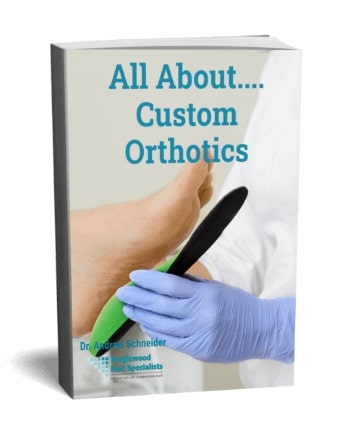
Custom orthotics are prescription medical devices, fabricated from a three-dimensional mold or digital scan of your  foot, designed to correct your specific biomechanical alignment and redistribute how your body's weight travels through your feet. Unlike over-the-counter insoles, they're built to a clinical prescription derived from a full podiatric examination — meaning no two pairs are alike.
There are two main types, and they serve very different purposes. Functional orthotics are made from semi-rigid materials — graphite or polypropylene — and they're designed to control abnormal foot motion. Accommodative orthotics use softer, more flexible materials to cushion and offload pressure, which is what I typically use for diabetic foot conditions and arthritis. The type I prescribe depends entirely on what I find during your examination, not on a shelf category.
Here's what most people don't realize: the lab that builds your orthotics follows my instructions exactly. Which means if I get the prescription wrong, you get a beautifully fabricated device that does nothing useful. The value of a custom orthotic isn't in the materials — it's in the clinical thinking that drives the prescription.
Think of them the way you think about eyeglasses. While I'm wearing my glasses, I can see. Take them off and I can't. A custom orthotic compensates for your lower extremity mechanics while you're wearing it — it doesn't permanently fix your foot structure any more than glasses permanently fix your vision.
That's not a flaw in the design. That's how they're supposed to work. And once you understand that, the question shifts from "why do I need these?" to "why didn't I get them sooner?" For people dealing with flat feet and high arches, that distinction matters enormously. Our custom orthotics and digital gait analysis service walks through the full evaluation process.
The Difference Between an Orthotic and an Insole
Let's clear this up, because it's where most of the confusion lives.
The insoles you buy at the drugstore are mass-produced for a statistical average foot — a foot that, in practice, almost nobody actually has. They're made from foam or gel, they compress within three to six months, and their job is to add cushioning. That's it. Nothing wrong with cushioning. But if your foot has a biomechanical problem — overpronation, supination, equinus, structural asymmetry — cushioning doesn't address it. You're just padding a problem that keeps happening.
I won't judge you for trying the drugstore insert first. Most people have. For mild, occasional discomfort, they're not nothing. But if you've been rotating through them for months and you're still hurting, that's your answer. Your foot isn't average, and your problem isn't going to be solved by a device that was designed for one.
There's a third category worth mentioning: the "custom" kiosks you find at mall stores or online services. These typically use a prefabricated shell that gets adjusted marginally based on a basic foot scan. They're not true custom orthotics — there's no clinical examination, no biomechanical prescription, and no physician directing the fabrication. They sit somewhere between an OTC insole and a real custom device, and they're priced to suggest they're the latter.
Do the math and it's actually pretty close: two pairs of $30 drugstore insoles per year versus a true custom orthotic at $700 that lasts two to five years comes out to roughly the same cost per day. The clinical difference is not even close. For anyone dealing with chronic plantar fasciitis or persistent heel pain, that gap matters — and so does understanding why the custom vs. OTC orthotics guide draws such a clear line between the two.
How Custom Orthotics Are Made — The Full Process
Most articles describe the lab half of this process and skip the clinical half entirely. That's backwards. The examination and prescription are where the real work happens — the lab just executes the instructions. Here's how it actually works, start to finish.
Step 1 — The Biomechanical Examination
 This is where everything begins, and it's the step that separates a custom orthotic from everything else on the market. In my Tanglewood practice, I typically spend 20–30 minutes on the biomechanical evaluation before I think about casting. I'm assessing joint mobility — your subtalar joint, ankle dorsiflexion, first metatarsophalangeal range of motion — along with muscle flexibility, calf tightness, arch structure, and whether there's any leg length discrepancy at play. Every finding shapes what I prescribe.
A new patient visit runs $185; established visits are $120. That examination is the foundation of every clinical decision that follows. Skip it — or rush through it — and the orthotic you receive is essentially a guess.
Step 2 — Gait Analysis
After the examination table, I watch you walk. I'm looking at your heel strike pattern, how much your midfoot collapses, where your weight shifts from heel to toe, and how your knee tracks over your foot. Your foot is the bottom link in a kinetic chain that runs through your ankle, knee, hip, and lower back. When it's misaligned, every structure above compensates.
I'm watching your whole chain move, not just your foot. That's why I evaluate gait at our office both barefoot and in your shoes — the difference between the two tells me a lot about what your current footwear is doing to the problem.
Overpronation, supination, and equinus — excessive calf tightness that limits ankle mobility — produce entirely different orthotic designs. Two people can both have heel pain and need two completely different prescriptions.
Step 3 — Capturing the Impression
 This is the most technically demanding step in the entire process, and the one where errors have the biggest consequences. I capture your foot either in a traditional plaster or fiberglass slipper cast or via 3D digital scan — both methods produce accurate results when performed correctly. The non-negotiable isn't the method; it's the position.
Your foot must be captured in subtalar neutral — the specific angle where your foot and ankle joints are optimally aligned, not where they habitually sit when you're standing. Capturing your foot in the wrong position is like measuring for glasses with the wrong prescription — the lab will execute it perfectly and produce something perfectly wrong, which is why I don't delegate impression-taking. Both plaster casting and 3D scanning produce reliable, clinically valid impressions when performed by an experienced clinician — the method matters less than the position and the hands doing the work.
Step 4 — Writing the Prescription
After treating thousands of patients, I can tell you that the single biggest predictor of whether orthotics help is the quality of the examination — not the lab, not the materials, not the brand. The prescription I write specifies shell material (rigid graphite for maximum motion control, polypropylene for a balance of control and flexibility, or EVA foam for accommodative offloading), shell thickness, forefoot and rearfoot posting angles, top cover material, and any specialty accommodations — metatarsal pads, heel lifts, cutouts for painful structures. Every one of those decisions traces directly back to what I found during your evaluation, and 25 years of clinical pattern recognition go into each one.
That's not something a kiosk replicates. My full clinical background is on my bio page if you want to know more.
Step 5 — Lab Fabrication (7–10 Business Days)
Your cast or digital scan goes to the lab, where technicians CNC-mill or thermoform the shell over a model of your foot at the exact specifications I prescribed. The top cover gets cut and bonded to the shell, posting is applied at my specified angles, and the finished device gets checked against the prescription before it ships. For anyone with complex mechanics — significant overpronation combined with Achilles tendinopathy, for example — that precision is what makes the device actually work.
Step 6 — Fitting and Adjustment
When your orthotics arrive, you come back in. I don't hand them over at the front desk. I verify fit, function, and comfort before you leave — and I make chairside modifications on the spot if anything needs refinement: grinding pressure points, adding targeted padding, adjusting posting.
Most people need one follow-up adjustment visit within the first two to three weeks. That's not a problem; it's part of the process. Break-in protocol is two to three hours per day initially, increasing by one hour daily until you're wearing them full-time.
Pricing at a glance:
- Custom orthotics (exam + impression + prescription + fabrication + fitting): $700
- Additional pair built to the same prescription (for a different shoe type): $350
- Lifespan: 2–5 years depending on activity level and body weight
When Orthotics Aren't the Full Answer — Regenerative Medicine in Houston
Orthotics correct how your foot moves. They don't heal tissue that's already been damaged. And here's what I see constantly: people come in dealing with chronic pain layered on top of a biomechanical problem. They need both — the orthotic to stop the ongoing aggravation, and regenerative medicine to repair what's been hurt.
Shockwave Therapy ($300/session | $750 three-session package)
Think of shockwave therapy like aerating a lawn. Acoustic waves create microchannels in chronically inflamed tissue,  allowing healing factors to penetrate structures that have essentially been cut off from the body's repair mechanisms. It restarts a healing response that stalled out — what I think of as a construction crew that started a job and never finished it.
I use shockwave therapy for chronic plantar fasciitis and Achilles insertional pain regularly, and I use it on my own heel. The success rate is 82% over a three-session protocol, with progressive improvement continuing over 8–12 weeks following treatment. A 2024 systematic review and meta-analysis found ESWT significantly outperforms placebo for plantar fasciopathy across multiple outcome measures.
PRP Injection — DPMx ($850)
Platelet-rich plasma is your own blood, drawn and processed in a centrifuge to concentrate the growth factors and signaling proteins your body uses for tissue repair, then injected under ultrasound guidance directly into the damaged structure. I call it liquid gold for healing — not because it sounds good, but because what it actually does is remarkable. PRP injection produces significant improvement in 70–80% of chronic tendon and fascial injuries when used as a standalone treatment. Research published in Cureus confirms PRP's role in stimulating tendon repair through concentrated growth factor delivery to damaged tissue.
The Combined Protocol — Seeds and Soil (~$1,600)
When I combine PRP and shockwave, I think of it this way: PRP provides the seeds — the concentrated biological ingredients your tissue needs to repair itself. Shockwave prepares the soil — it creates the optimal tissue environment for those ingredients to actually work. Together, the combined success rate rises to 85–95%.
That's the protocol that almost makes surgery obsolete for chronic soft-tissue injuries I used to routinely refer for surgical consult. Our regenerative medicine for foot pain overview covers how these treatments work together, and the what regenerative medicine does for foot pain library article goes deeper on the clinical rationale.
For the vast majority of people I treat in Houston for chronic foot pain, the combination of custom orthotics plus regenerative medicine means surgery never comes up.
Chronic foot pain that won't quit?
Custom orthotics and regenerative medicine work together. Let's find the right combination for your foot.
Schedule Your Evaluation →
What to Expect at Your Houston Orthotics Appointment
When you come in, I'll start by asking what you're actually dealing with — not just the pain, but your goals. Are you trying to get back to running? Stand through a full shift without dreading the next morning? Walk to dinner without planning around how your feet will feel afterward? That tells me what I'm building.
Then I'll take a full history: how long you've been hurting, what you've tried, what helped and what didn't.
From there I move into the biomechanical examination — joint mobility, muscle flexibility, arch and deformity assessment. I'll check your subtalar joint, your ankle range of motion, your first metatarsophalangeal joint, and I'll assess your calf flexibility, because equinus — tightness in the calf complex — is one of the most common drivers of foot pain that nobody identifies until a podiatrist looks for it.
After the table exam, I'll watch you walk. Barefoot first, then in your shoes. I'm building a picture of your entire kinetic chain, not just the spot that hurts. The whole evaluation typically takes 20–30 minutes.
Once I know what I'm looking at, I'll walk you through everything — what I found, what I'm prescribing, and exactly why. I'll explain the shell material I'm choosing, the posting angles, any accommodations I'm adding, and what I expect those choices to do for your specific mechanics. No surprises. Then we capture the impression and your prescription goes to the lab. Your orthotics will be ready in 7–10 business days, and you'll come back for a fitting visit before you take them home.
Most people feel meaningful improvement within the first two to four weeks of consistent wear. Full adaptation — where the device feels natural and the underlying pain has resolved — typically happens by weeks six to eight. Orthotics aren't aspirin. They work when you wear them consistently, and they work best when the examination driving them was thorough.
If you're dealing with recurring running injuries or symptoms that have been building for months, give the process the time it takes — the results are worth it. And if you want to schedule your evaluation, the process starts with a single appointment.
Who Actually Needs Custom Orthotics?
The honest answer is: not everyone. But more people than you'd expect.
The clearest candidates are structural — overpronation and high arches both create mechanical stress that accumulates over years, long before it announces itself as pain. Leg length discrepancy is another one that gets missed constantly, because even a small difference distributes force unevenly across your hip, knee, and foot with every single step. But structure is only part of the picture. Orthotics are a core part of how I treat bunions, hammertoes, Morton's neuroma and ball-of-foot pain, metatarsalgia, and diabetic foot conditions — especially where the goal is offloading pressure before it becomes an ulcer.
I also see a pattern here in Houston that's worth naming. Nurses and technicians from the Texas Medical Center logging 12-hour shifts on hard floors. Runners on the Memorial Park loop dealing with the same recurring injury every training cycle. Galleria-area professionals spending their evenings in shoes that were never designed for the amount of walking they do.
These aren't unusual cases — this is Houston. And for most of them, the problem has a mechanical answer that nobody's looked for yet.
Look, I know $700 sounds significant. But I also know what it costs — in money, time, and quality of life — to spend two years chasing symptoms that trace back to a mechanical problem nobody addressed. I prescribe orthotics when the examination tells me they're the right tool. Not before.
And when they're right, there's almost nothing else in my toolkit that changes someone's daily life as consistently. A 2023 CADTH systematic review confirms custom-made foot orthotics demonstrate meaningful clinical benefit across a wide range of lower limb conditions when properly prescribed.
Making Your Orthotics Last — Care and Maintenance
A lot of people treat their orthotics like set-it-and-forget-it. They work great, the cushioning breaks down, and then they wonder why they're hurting again. Here's what actually keeps them working.
Break in slowly: two to three hours per day for the first week, adding roughly one hour per day until you're wearing them full-time. Cleaning is straightforward — mild soap, warm water, air dry completely. Never apply heat. A dryer, a heating vent, even leaving them on a hot car seat can deform the shell in ways that change how they function. If they squeak, a thin layer of talcum powder or cornstarch between the orthotic and your shoe lining solves it.
The top cover — the cushioning layer bonded to the shell — compresses over time, usually faster than the shell itself wears out. When the cushioning flattens and you start feeling discomfort again, that's often a recovering situation, not a full replacement. Recovering replaces just the top layer at a fraction of the cost.
Significant weight changes — in either direction — may also affect fit and function and warrant a prescription review. If something feels off, bring them in. I'd rather check them than have you assume they've failed when a minor adjustment is all that's needed.