What Custom Orthotics Actually Do
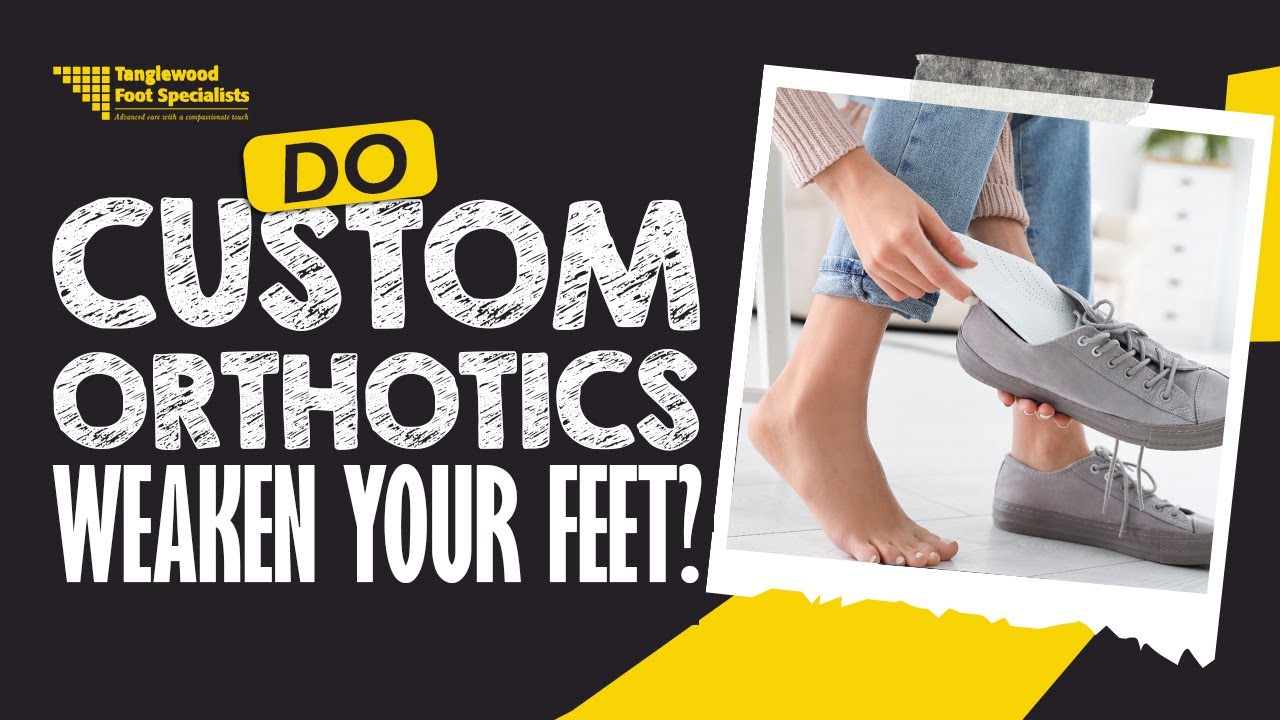
 Custom orthotics are prescription-fabricated shoe inserts, molded specifically to your foot's structure, designed to guide the mechanical forces traveling through your foot and leg during movement. Unlike over-the-counter cushion insoles, they address your individual biomechanical pattern — flat arches, high arches, overpronation — while your muscles remain fully active with every step. That distinction matters more than most people realize.
So here's what's actually happening when you put a custom orthotic in your shoe. The device redirects the forces moving through your foot — it doesn't eliminate muscle contraction. Your intrinsic foot muscles, the small muscles that live inside the foot itself controlling toe movement and arch stability, keep firing with every stride. The orthotic changes the mechanical environment they're working in, not whether they work at all.
Think of orthotic insoles like eyeglasses for your feet. While I'm wearing my glasses, I can see clearly. When I take them off, I can't. But the glasses didn't weaken my eyes — they compensated for my prescription so my eyes could do what they're supposed to do.
Orthotics work the same way. They compensate for your biomechanical pattern so your foot moves with less stress, less pain, and less cumulative damage to the structures that support you every single day.
And that's exactly where the cast comparison falls apart. A cast eliminates all muscle contraction — that's why muscles shrink inside one. A functional custom orthotic requires full muscle engagement with every step. The word "functional" is doing real work in that phrase, and it's the key to understanding why orthotics for heel pain and other conditions have the clinical track record they do.
Where the "Orthotics Weaken Feet" Myth Comes From
The idea didn't appear out of nowhere. It was popularized by the barefoot and minimalist running movement in the mid-2000s — Born to Run culture, Vibram FiveFingers, the argument that modern cushioned shoes and supports had disconnected us from our natural movement patterns. Some of those ideas have real merit. But the leap from "minimalist footwear strengthens feet" to "orthotics cause atrophy" borrows an analogy that sounds logical and fails mechanically.
Here's what most people don't realize: there's actually one peer-reviewed study that anti-orthotic voices cite more than any other — and most of them misread it. A 2020 study out of Wilfrid Laurier University found a 9–17% reduction in the cross-sectional area of three intrinsic foot muscles after 12 weeks of orthotic wear in flat-footed adults. Cross-sectional area is the physical size of a muscle as measured on a scan — different from how hard or efficiently it contracts.
When the same researchers measured actual muscle electrical activity using EMG, electromyography, the gold standard test for whether muscles are actually firing, they found no significant change. The muscles got slightly smaller in one measurement.
They didn't stop working.
The study's own authors recommended adding an intrinsic foot strengthening program alongside orthotic use — not eliminating orthotics. That's a very different conclusion than the one circulating on running forums. Adaptation and atrophy aren't the same thing, and a flat-footed adult's muscles redistributing effort under improved mechanical conditions is exactly what you'd want to see.
It's also worth noting what doesn't get this level of public scrutiny. Cortisone shots for plantar fasciitis are a widely accepted treatment — and repeated cortisone injections are proven to weaken tendons over time, with a documented risk of spontaneous tendon rupture. That's a real, published risk that most people accept without a second thought. Orthotics carry no equivalent documented structural risk, yet they're the ones being questioned.
The Right Question to Ask About Orthotics
 After treating thousands of patients over 25 years, I've stopped trying to answer the weakness question with a lecture on muscle physiology. It's not that the physiology doesn't matter — it does, and we just covered it. But the question itself leads people in the wrong direction, because it's about a metric when it should be about your life.
The right question isn't "will orthotics weaken my muscles?" It's simpler: will they help you do what you need to do — walk without pain, run the distances you want, stand through a full shift, keep up with your kids? That reframe isn't me dodging the science. It's me applying it to something that actually matters to you. I don't treat measurements; I treat people with places to go and things they want to get back to.
Here's something else worth understanding. Overpronation — excessive inward rolling of the foot with each step — doesn't stay in your foot. That mechanical pattern travels up through your ankle, knee, hip, and lower back. Think of your body as a chain: when the bottom link is misaligned, every link above it compensates.
When custom orthotics for plantar fasciitis or other conditions correct your foot mechanics, they're protecting the entire chain — not creating weakness, but preventing injury upstream. Orthotics don't just calm overactive muscles; they help engage underactive ones. That's not atrophy.
That's efficiency.
You might also want to know about regenerative medicine for foot pain for situations where orthotics alone aren't enough — but we'll get to that. First, let's look at what the full body of evidence actually says.
How a Houston Podiatrist Approaches Foot Pain and Orthotics
In my practice near the Tanglewood and Galleria areas of Houston, I've never prescribed custom orthotics as the only answer — or even the first one. They are one tool in a progression, and my job is to figure out which tools your situation actually calls for. What follows is exactly how I think through that progression, and how I explain it to every person who comes through my door.
Level 1: Lifestyle Changes
Sometimes the right starting point is simpler than you'd expect. A footwear audit alone can produce meaningful improvement — replace shoes with compressed midsoles or no midfoot structure, and you've already changed the mechanical environment your foot is working in. One thing Houston's climate makes worse: heat accelerates foam compression in athletic shoes, so a pair that holds up two years somewhere cooler may need replacing in 12–14 months here.
Activity modification during acute flares matters too, and so does weight. Every additional pound translates to roughly 1.5 pounds of force at the foot walking, and up to three times that running. Even modest changes reduce mechanical load in ways you'll actually feel.
Level 2: At-Home Care
Calf and Achilles stretching twice daily — 30 seconds each, consistent — directly reduces tension on the plantar fascia and is one of the most evidence-backed interventions I can recommend without an office visit. I'd pair that with intrinsic foot strengthening: towel scrunches, marble pickup, single-leg balance. The barefoot advocates aren't entirely wrong that intrinsic strength matters.
I can prescribe both orthotics and a strengthening routine. These are not competing approaches; they work better together than either does alone.
What doesn't work is worth naming directly. Gel cushion insoles address comfort but don't correct biomechanics. Massage guns give temporary sensory relief without touching structural issues, and going barefoot on hard floors is counterproductive for most structural foot conditions. At-home care can reduce symptoms meaningfully — it rarely corrects the underlying pattern driving the pain.
Level 3: Conservative In-Office Treatment
When lifestyle and at-home measures haven't moved things enough — or when you've got a biomechanical pattern that needs more than stretching to address — this is where I spend most of my clinical time. Prescription orthotics at Tanglewood Foot Specialists are $700 for the initial pair ($350 for a second pair). Each pair is fabricated from a 3D scan or plaster mold of your specific foot — not a generic size pulled from a bin — and built to my exact specifications based on your gait analysis and exam findings.
Most people notice improvement within two to four weeks. Meaningful pain reduction typically arrives by weeks four to six, with full benefit usually apparent by three months. That timeline is why I ask people to give orthotics a real trial before drawing any conclusions about whether they're working.
Physical therapy alongside orthotics — not instead of them — is worth considering when muscle imbalances or strength deficits are part of the picture. Nobody would tell a post-knee-injury patient to skip PT because they're wearing a brace; the same logic applies here. Six to eight weeks of targeted strengthening produces measurable results that support what the orthotic is doing mechanically.
For acute inflammatory flares, a cortisone injection ($120) can bring pain under control in three to five days, which creates a window to begin the rehabilitation work that actually addresses the cause. But I want to be honest about cortisone: repeated injections are proven to weaken tendons over time and carry a documented risk of spontaneous tendon rupture. It's a short-term tool, not a strategy.
Level 4: Advanced Regenerative — The Third Option
In most medical offices, if conservative care fails, the next conversation is surgery. I think there is a third option most doctors never mention — and after watching it work in my practice, I'd be doing you a disservice not to explain it clearly.
Here's the problem with chronic foot pain that doesn't respond to conservative care: the tissue isn't healing because the body's repair process has stalled. Think of it like a construction crew that started the job and never finished — the scaffolding is up, the materials are there, but nothing's moving. Shockwave therapy for plantar fasciitis restarts that process — acoustic waves create microchannels in damaged tissue, allowing blood flow and healing factors to reach areas that have been starved of them.
It's $300 per session, or $750 for a three-session package — three weekly sessions, no anesthesia, walk out the same day. Initial improvement typically shows up two to four weeks in, with full benefit at three to six months. And if you're wondering is shockwave therapy painful — less than most people expect, and the published success rate for plantar fasciitis sits around 82%.
PRP for plantar fasciitis takes a different approach but addresses the same stalled repair problem. We draw a small amount of your blood, process it to concentrate the platelets — the cells that carry your body's healing growth factors — and inject that concentration directly into the damaged tissue. Platelet rich plasma treatment runs $850 and carries a 70–80% success rate for chronic tendon problems.
Unlike cortisone, PRP doesn't just reduce inflammation temporarily — it initiates actual tissue regeneration. When I combine it with shockwave, PRP first to introduce the growth factors and shockwave days later to prepare the optimal environment, the combined success rate rises to 85–95% for chronic conditions at about $1,600 total (FSA/HSA eligible). Understanding PRP vs cortisone before committing to either is worth your time — the differences in mechanism, durability, and risk profile are meaningful. For the full landscape, types of regenerative medicine covers every option in detail.
Level 5: Surgery — When It's Actually Necessary
For plantar fasciitis — the condition most commonly treated with orthotics — roughly 95% of cases resolve without surgery. Read that number again. That number is real, and it's why I work through every level of this progression before we have the surgical conversation. But if you've reached this point, it's because conservative care and regenerative options have genuinely been exhausted — not because I gave up early.
Look, I know foot surgery sounds scary. But plantar fasciitis surgery — a partial, endoscopic plantar fascia release — is far less invasive than it was a decade ago. The first week involves protected weight-bearing in a boot, elevation, and wound care, with protected walking typically resuming in week two. Physical therapy starts around weeks three to six, with gradual return to normal footwear and most people back to low-impact activity by months two to three.
Long-term pain resolution runs 75–90%. Most people who go through it tell me afterward they wish they'd done it sooner — not because earlier surgery was the right call, but because by the time we get there, they've been managing the pain for a long time. The relief, when it comes, feels significant.
Still Not Sure What Your Feet Need?
I'll do a full biomechanical evaluation and tell you honestly what's going on. Schedule Your Evaluation
Do Orthotics Work? What the Evidence Actually Shows
I won't judge you for being skeptical. The internet is full of confident people telling you orthotics are a scam — and some of them have large audiences and compelling anecdotes. But when you look at the peer-reviewed evidence, the picture is consistent in a way that anecdote rarely is.
EMG studies — measuring actual muscle electrical activity during movement — consistently show that orthotic use maintains or improves muscle firing patterns, not the opposite. The 2020 size-reduction finding we discussed earlier is real, but it exists inside a body of literature that points clearly the other way on function. A modest reduction in muscle cross-sectional area in a flat-footed adult whose foot mechanics have just been corrected is what load redistribution looks like, not atrophy. The muscle is working more efficiently, not shutting down.
The broader clinical picture supports this. Roughly 95% of plantar fasciitis cases — the condition most commonly driving orthotic prescriptions — resolve without surgery when conservative care including orthotics is followed consistently. That number comes from decades of outcomes data, not a single study. And no published research demonstrates that orthotics cause functional weakness or reduced physical performance.
The absence of that evidence, after 50-plus years of widespread orthotic use, is itself a meaningful data point. If functional weakness were happening at a clinically significant level, we'd know by now.
For anyone wanting to go deeper on regenerative treatment for heel pain when orthotics alone aren't enough, or on managing heel pain treatment at home alongside conservative care, I've put together detailed guides on both.
Can You Strengthen Your Feet While Wearing Orthotics?
Yes — and I actively recommend it. This is one of the places where the barefoot movement got something right, even if they drew the wrong conclusion from it. Intrinsic foot strength genuinely matters, and orthotics don't prevent you from building it. The two approaches work better together than either does alone.
The exercises I recommend most often are simple and require no equipment: towel scrunches, marble pickup, single-leg balance holds, and calf raises. Done consistently — ten minutes, twice a day — these directly strengthen the intrinsic foot muscles and the posterior chain that supports your arch. The parallel is the same one I use with knee injuries: wearing a brace doesn't mean skipping physical therapy. For more on plantar fasciitis exercises — including which ones move the needle and which aren't worth your time — I've covered that in detail, and a custom orthotic evaluation can clarify the full picture.
Whether you're logging miles on Memorial Park trails or standing eight hours on concrete at a Galleria retail job, strong intrinsic foot muscles make a real difference in how your feet hold up. I want both for you: the mechanical support orthotics provide and the underlying strength to work with it. If heel pain when running has been keeping you off the trails, that combination — orthotics plus a targeted strengthening routine — is often exactly what closes the gap between managing pain and getting back to full activity.
What to Expect When You Come to My Houston Podiatry Practice
When you come in, I'll start by asking what you want to be able to do — not just where it hurts. That question matters more than you'd think, because it changes everything about how I approach your care. A runner trying to get back to marathon training and a retail worker logging eight hours on concrete have different goals, and the plan I build for each of them looks different even when the diagnosis is the same.
From there, I'll do a full biomechanical exam: range of motion, arch structure, joint alignment, and a pressure mapping study that shows me exactly where force is concentrating in your foot. Then I'll watch you walk. Compensation patterns in your gait often explain symptoms that don't make sense on imaging alone — and they tell me a lot about what's actually driving the problem versus what's just a downstream effect of it. Dr. Andrew Schneider has been doing this evaluation in the same Houston practice for 25 years, and the gait analysis piece is still the part that surprises people most.
If custom orthotics are indicated, I'll take a 3D scan or plaster mold of your foot at the same visit — fabricated to my exact specifications, not a generic size. You'll come back at six weeks so I can assess fit and function, make any adjustments, and check progress against your goals. If orthotics are not the right answer for you, I'll tell you that directly and explain what is.
Either way, I need to see you — because guessing at what your feet need never works as well as actually looking at them. To get started, request your appointment online or reach me directly at 713-785-7881.
Your Goals Deserve the Right Foundation
Asking questions before committing to any treatment is exactly what an informed person should do. The concern that orthotics might weaken your feet is understandable — not paranoid, not uninformed, and rooted in wanting to make a smart decision. Properly prescribed custom orthotics don't weaken your feet. The mechanism is clear, the research is consistent, and what they do is give your foot the structural support it needs to stop compensating, stop hurting, and start doing what you actually need it to do.
I won't judge you if you're still skeptical. I'd rather you walk in with questions than avoid getting help because the internet gave you a confident answer that turned out to be wrong. Orthotics may be part of your solution, or they may not be — but you won't know until we actually look at your foot, watch you walk, and understand what you're trying to get back to doing. That's a conversation worth having, and it starts with one appointment.
Hoping doesn't work. A phone call does. Reach me at 713-785-7881 or schedule your evaluation online — Houston podiatrist Dr. Andrew Schneider will tell you exactly what your feet need, and what they don't.
Your Goals Deserve the Right Foundation
Let's figure out exactly what your feet need — and what they don't. Request Your Appointment